

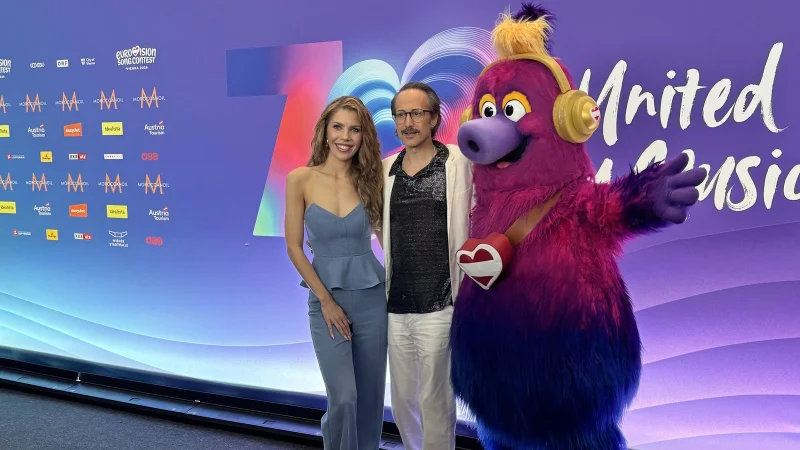
Vienna’s Eurovision Song Contest has drawn sharp criticism for what some on site called a lack of originality, with the show’s moderation team of Victoria Swarovski and Michael Ostrowski taking most of the blame. The reaction landed as the 69th Eurovision Song Contest in 2025 moved through its live broadcasts in the Austrian capital, where the hosts’ opening numbers and the production drew comparisons no organizer wanted.
Max Sieber, a veteran figure in the contest’s orbit, attacked the ORF production with a line that captured the mood of the criticism. “Es klauen ja alle in dem Gewerbe. Aber so schlecht zu klauen, ist eigentlich strafbar,” he said, before adding: “Oder waren Sandra Studer und Hazel Brugger einfach so gut?” The comparison pointed straight back to Basel, where the 2024 contest had been widely praised for its hosts and energy, and where fans on site said they had felt a real dedication to the Eurovision Song Contest.
That is why the questions around Swarovski matter today. She was one half of the duo fronting Austria’s home contest, and the reception to their work became part of a wider judgment on whether Vienna was living up to the standard set by Basel and even the last time the city hosted in 2015. Fans at the arena complained that Swarovski and Ostrowski did not click on stage and said the pair lacked the harmony they had seen from Sandra Studer and Hazel Brugger, as well as from other hosts in previous years.
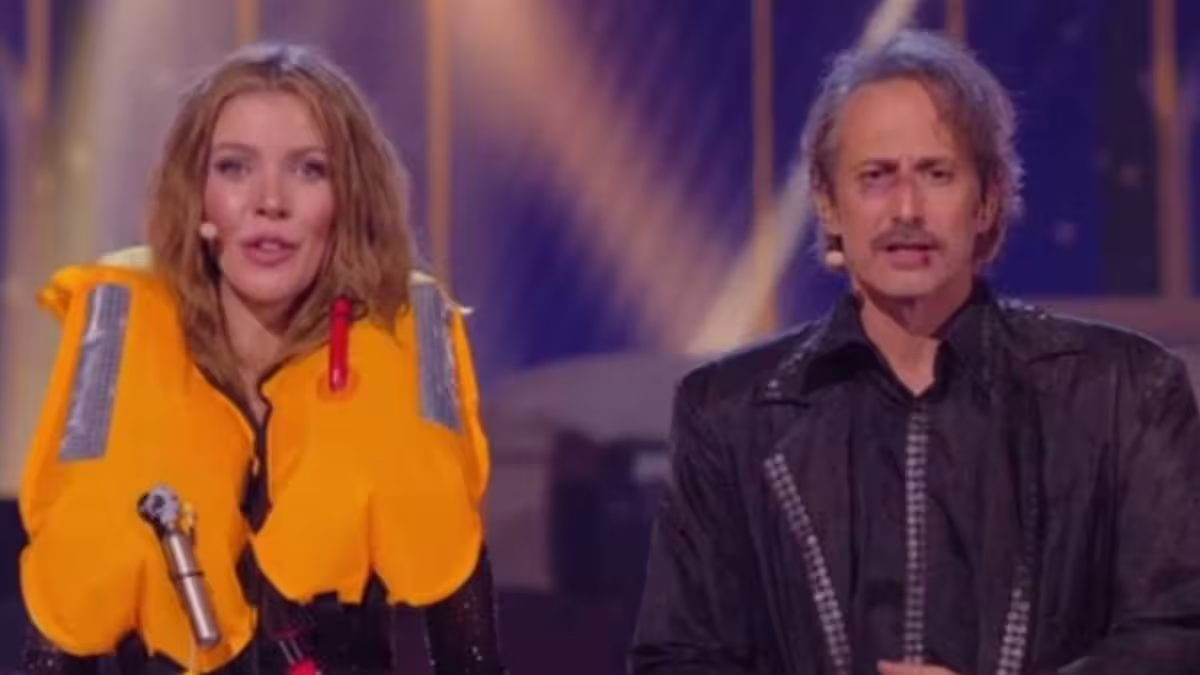
The sharpest backlash came after the second semifinal opening number, when the duo parodied the winning performance by JJ from the previous year in Basel. Edward af Sillén, who also wrote numbers for the contest in Stockholm in 2016 and Malmö in 2024, reacted with exasperation. “Zum Glück ist das kein Humor-Wettbewerb, den wir hier schauen,” he said, before adding, “Um Himmels willen...” He warned, “Es gibt ein Risiko, dass fünf weitere Länder den Event nach dieser Nummer boykottieren,” a line that landed against the backdrop of five countries already boycotting the ESC this year over Israel’s participation.
The contest’s problems were not limited to the stage banter. Austrian hopeful Veronica Fusaro was eliminated in the semifinal after a run of rehearsal complications that she said left her frustrated. One first rehearsal used the wrong adhesive material for the ropes on a prop. At the second rehearsal, an object was pushed onto the stage too late. By her first general rehearsal, several props were missing altogether, only to be found later in a warehouse by mistake. “Ich habe mir das professioneller vorgestellt,” Fusaro said.
Vienna still had the trappings of a major Eurovision city. A party tram ran from the Eurovision Village on Rathausplatz to the Stadthalle, tickets were still available during the week, and hotel prices remained moderate. But the atmosphere around the show suggested something less than a triumphant homecoming. The current Vienna edition was widely seen as falling short not just of Basel’s polished 2024 production, but also of the city’s own 2015 contest, which many now remember more fondly than the 2025 return.
So who is Victoria Swarovski? In this contest, she was not just a presenter with a famous name. She was one of the faces of a Vienna Eurovision edition that drew criticism for weak chemistry, borrowed ideas and a production many felt did not match the event’s ambition. In a year when the hosts were judged against Basel’s standard and the show itself was shadowed by boycotts, Swarovski became part of the answer to a simple question: this was the woman helping lead a Eurovision that many believed did not rise to the moment.