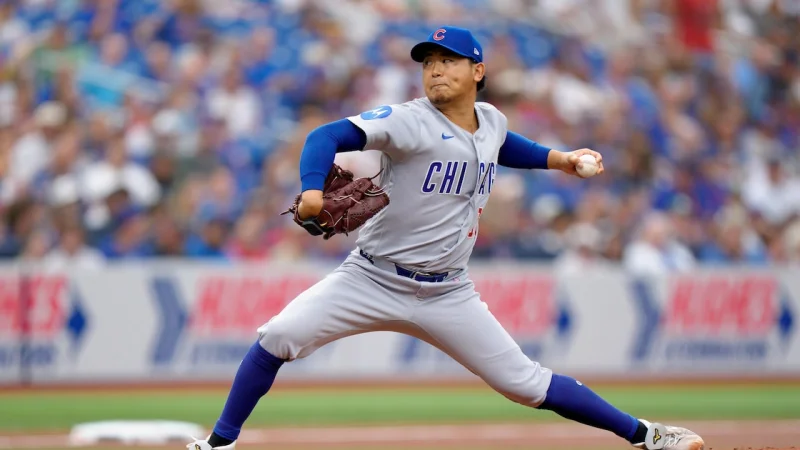
Shota Imanaga has agreed to a contract with the Texas Rangers, according to reports, ending his brief return to the Chicago Cubs and giving Texas a new arm for the back half of its rotation. 's Jesse Rogers first reported the agreement, and Ken Rosenthal of The Athletic said the deal runs three years.
The financial shape of the contract puts it just above the $48 million Foster Griffin received from the Cleveland Guardians, which suggests a commitment in the neighborhood of that mark rather than a massive outlier. For Texas, the move is being framed as an upgrade over Jack Leiter in the back half of the starting staff, a sign the Rangers were looking for stability rather than another wait-and-see option.

Imanaga, 33, had spent his major league career with the Chicago Cubs before this latest move. That history makes the switch notable because he had already gone through a full decision cycle with Chicago in November 2025, when the club decided against extending his contract to a fifth year. He was then able to exercise a $15 million player option for 2026, declined it, became a free agent and later returned to Chicago on a one-year, $22 million deal.
That second Cubs stint made the new agreement harder to miss. Imanaga made 32 appearances for Chicago in 2025 and posted a 3.77 ERA, a 1.10 WHIP and 174 strikeouts in 174.1 innings, solid enough production to keep him in demand. He also was an All-Star in 2024, finished fifth in National League Cy Young voting and led the league with a 6.21 strikeout-to-walk ratio that season, when he finished with a 2.91 ERA, a 1.02 WHIP and 174 strikeouts in 173.1 innings.
Chicago's injuries around the pitching staff help explain why Imanaga's value was so visible to the Cubs last season, even with Cade Horton, Justin Steele and Ben Brown sidelined at different points. He helped push the club toward the playoffs in 2025, which makes the turnaround to another move all the more abrupt. The unanswered piece now is the final price of the Rangers deal beyond the reported three-year term and comparison point, but the direction is clear: Texas has added a proven starter, and Chicago is once again moving on without him.