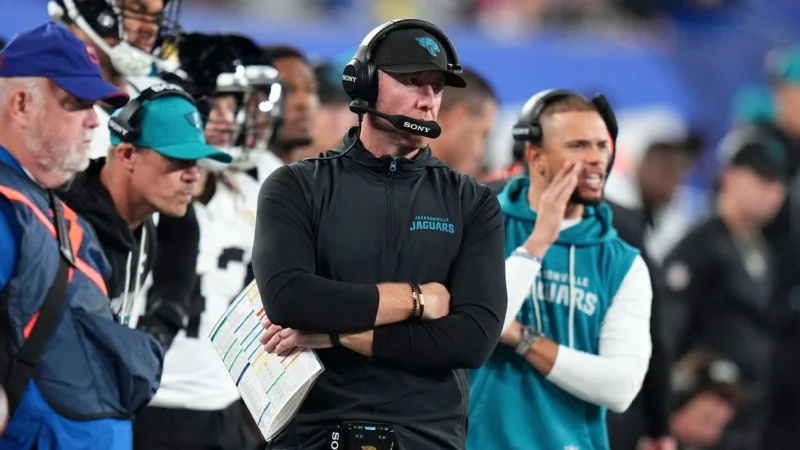
The Jaguars left Sunday’s loss to the Giants with two fourth-quarter decisions under the microscope, but the analytics view gave the late field goal a much thinner edge than the reaction suggested. Down eight with 3:40 left, Jacksonville chose a field goal attempt instead of a fourth-down gamble, and Analytics said either path carried almost the same win probability.
That is why the play is being searched now. The Jaguars fell 23-18, and the late-game arithmetic made the choice look bigger than the result on the scoreboard. Analytics said kicking or going for it both sat at 13.7 percent win probability, while a fourth-down try was estimated to succeed 32 percent of the time. In other words, the decision that drew so much attention was not a clear analytics mistake.
The earlier call at 6:39 in the fourth quarter was easier to defend on paper. Trailing by eight, the Jaguars went for two and Analytics said that choice improved their chance to win by 1.4 percentage points. The model said a 35 percent conversion rate was enough to justify the attempt, and the league average 2-point rate is 48 percent. Put simply, once a team is behind by eight, the math starts to work against playing for the extra point. A trailing team that gets to seven points still needs another score to win, while one that cuts the margin to six can survive with a touchdown and a standard extra point. That is why the value of two-point tries changes so sharply depending on the score.

The field goal at 3:40 was the more surprising sequence because it came after the Jaguars had already shown a willingness to chase the win aggressively. Yet the numbers explain why the call was not as lopsided as it looked in real time. Analytics estimated a 32 percent chance of conversion on fourth down, almost close enough to make either choice defensible. The field goal would have left the Jaguars down five, still needing another drive and another stop, but the gap between the two options remained small enough that the analytics model did not punish the kick.
That is the friction in the day’s game-management story. The Jaguars were criticized for conservative thinking on one snap and boldness on another, but the data point to a different conclusion: the two late decisions were not opposites so much as separate answers to a game that had already narrowed into one-score logic. Analytics even noted that going for two down eight late is virtually always worth it starting around halfway through the third quarter, which makes the first decision unsurprising and the second far less controversial than it first appeared.
What remains unresolved is the simplest part. The numbers can explain why the field goal was acceptable, and they can show why the two-point try made sense, but they cannot say why Jacksonville chose one answer over the other in the moment. That is the question left by Sunday: not whether the Jaguars had a mathematical case, but which instinct drove them when the game was still there to be won.