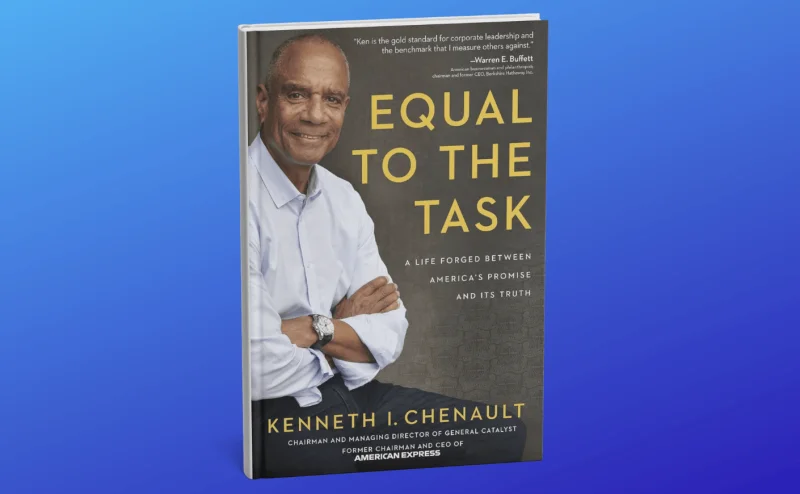
Ken Chenault's memoir, Equal to the Task, is set for release on Tuesday, Nov. 3, putting one of American business's most closely watched leadership stories back in view just as readers look for a fresh take on race, ambition and power. The book arrives with Chenault's own account of how he rose through elite institutions and into the top tier of American Express.
That path began in Hempstead, NY, where Chenault was raised by a father who worked as a dentist and a mother who was a dental assistant. Born in 1951, he went on to Bowdoin College in 1970, later attended Harvard Law School and worked at Bain Consulting before beginning a career that would span 37 years at American Express, including 17 years as CEO until he retired in early 2018.
The timing matters because the memoir is not just a career recap. It is being released on Election Day, and its frame is political as much as personal: Chenault has long described a life shaped by the civil rights era and by a belief that business leadership can carry a public purpose. He has said that a "vision of a brighter, more equitable America provided a guiding sense of purpose, a North Star for my young mind to orient toward."

Yet the book also draws force from what he encountered when he arrived at American Express in 1981. Chenault wrote that he did not find a single black person in senior management, even as he was moving into the company that would define his career. "I hadn’t set out to be a pioneer but it was starkly clear that I was one," he wrote. That friction is central to the memoir's appeal: he became a top executive inside a system that still had no one who looked like him at the top.
Long before that, Chenault was already wrestling with questions of representation and responsibility. At Bowdoin College, he was the youngest person in Nelson Rockefeller's discussion group, and his senior thesis explored black student experiences at the school. He later recalled hearing Martin Luther King Jr. speak near his hometown two weeks before King's assassination, a moment that helped shape the moral language he would carry into his career. In the memoir, he closes that arc with a line that reads less like nostalgia than a promise: "I may not be there with you, but you will get to the promised land."
What comes next is the book itself, and the questions it is likely to reopen. Readers will be able to see how Chenault connects his early life, his rise at American Express and his reflections on race into one account of leadership. The release on Tuesday puts that story in the market at exactly the moment he wants it read: as a memoir about success, and about the cost of being first.