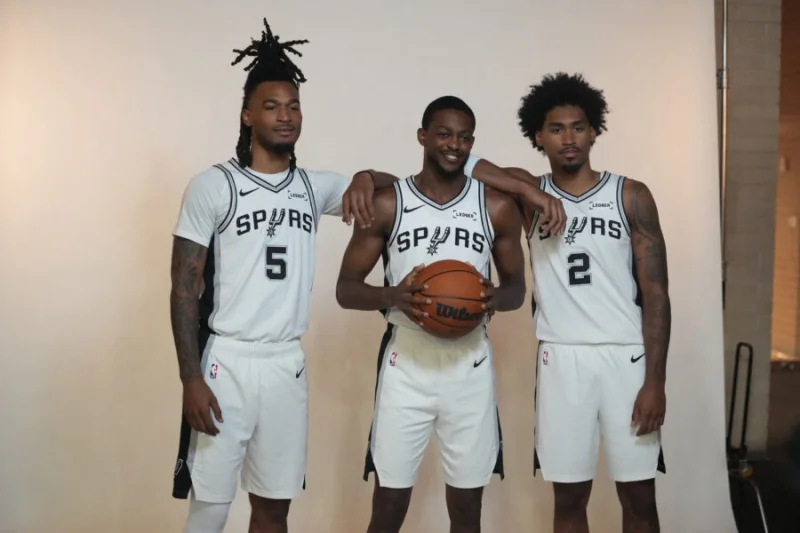
The Spurs opened their season on Tuesday with a new three-guard starting lineup, and it took time to settle in. Dylan Harper replaced Julian Champagnie in the five, but the group was shaky in the first half of the loss to Oklahoma City before looking more settled after intermission.
That change matters because it alters more than one spot in the rotation. Mitch Johnson no longer has the option of shifting the game’s tone by sending Harper in as a bench spark, and he had to manage De’Aaron Fox differently from the start.

Fox was the first guard Johnson pulled, then brought back later to run the offense with the second unit. That arrangement did not click right away. Fox could not mesh cleanly with Champagnie or Keldon Johnson as secondary creators, and the result was a stretch of turnovers and other empty possessions that slowed the offense down.
The alignment also shows why this kind of move has stayed in the conversation since the playoff run. It gives the Spurs more size and more handling on the floor at once, but it takes away the easy bench answer Harper had provided. Instead of changing the flow of the game from the sideline, Johnson is asking the new starting group to create its own rhythm from the jump.
There was at least one sign the setup can work. In the second half, the three guards stayed on the floor while Champagnie entered for Devin Vassell after Vassell picked up his fourth foul, and the five looked better with that added time together. Even so, it may take several games for the arrangement to be worked out, and Harper said the group is still not close to finished. “The biggest thing is just, for me at least, communication,” he said. “Just making sure we’re all on the same page.” He added that the goal is to play for one another and know the group has each other’s back, but said the Spurs still have “a ways to go in all areas of the game.”