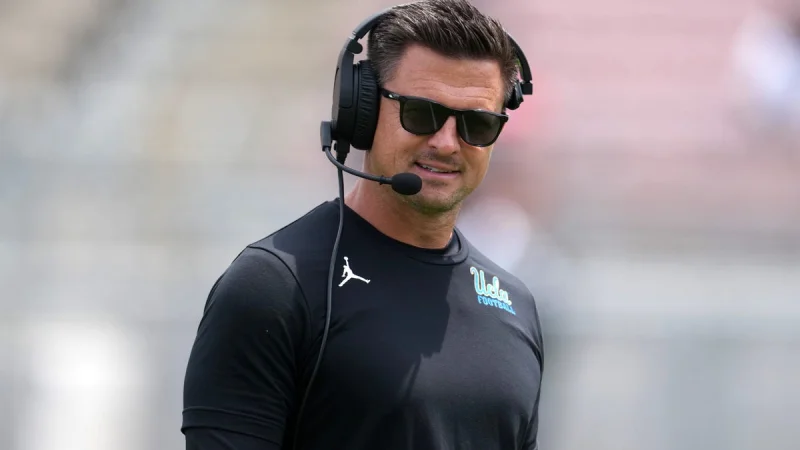
Nico Iamaleava drew attention at UCLA practice on Wednesday as the Bruins sharpened an offense that will be built around him when they travel north to play Cal on Saturday night. Offensive coordinator Dean Kennedy said every part of the scheme starts with the quarterback, and that UCLA will lean on a mix of personnel groups rather than a fixed script.
Kennedy described Iamaleava as having “a juice and aura about him” that reflects how much work he has put in, and said he is “beyond confident” entering the opener. That matters because UCLA is not just asking one quarterback to lead the offense; it is asking him to do it while the staff keeps shifting bodies around him and has yet to release a depth chart.
The Bruins have tried to preserve flexibility for as long as possible. Kennedy said UCLA will sift through multiple personnel looks and alter its skill positions depending on the situation, with two-tight end sets, three-wide receiver sets and other combinations all part of the plan. He said the variety of bodies and skill sets “leads to creativity,” and that the offense is designed to change shape without losing its identity.

That approach makes the timing around Saturday night more meaningful. UCLA is still sorting out some of the lineup details, but the offensive line has clearer anchors: Jordan Davis is locked in at left tackle, Hall Schmidt has been praised by Chesney for being “solid” and “playing with an edge,” and Carter Sweazie and Eugene Brooks are set to work at the guard spots. Riley Robell also returned to practice from a knee injury ahead of Saturday’s opener, and Wayne Knight said his presence helps keep the line on the “same page.”
The offense’s moving parts are not limited to the line. In 12-personnel, Josh Phifer, Harry Lodge or Braydon Loftin can line up on the line while the other works from the slot, and Knight, Jaivian Thomas and Anthony Woods can be used on running or passing downs. Knight’s experience matters after he caught 40 passes at James Madison in 2025, while Thomas and Woods have already shown they can run through the tackles.
UCLA’s 11-personnel packages are just as fluid. Brian Rowe Jr., Aidan Mizell and Landon Ellis can work outside, with Ellis and Mikey Matthews also able to function in the slot. Rowe surprised during spring camp with his ball-tracking ability, and Rodrick Pleasant praised him on Monday. Mizell has broken free on multiple deep routes, and Kennedy’s offense is counting on the quarterback-receiver timing to sharpen quickly enough to turn those chances into gains.
That is the part UCLA cannot fully script. The Bruins are building around Iamaleava and a flexible system, but the depth chart is still delayed and several roles are unresolved, which means the opener against Cal will test not just the talent on the field but how fast the pieces can move as one. If the timing comes together, UCLA’s offense can open up fast; if it does not, the variety Kennedy wants could become a moving target instead of an edge.