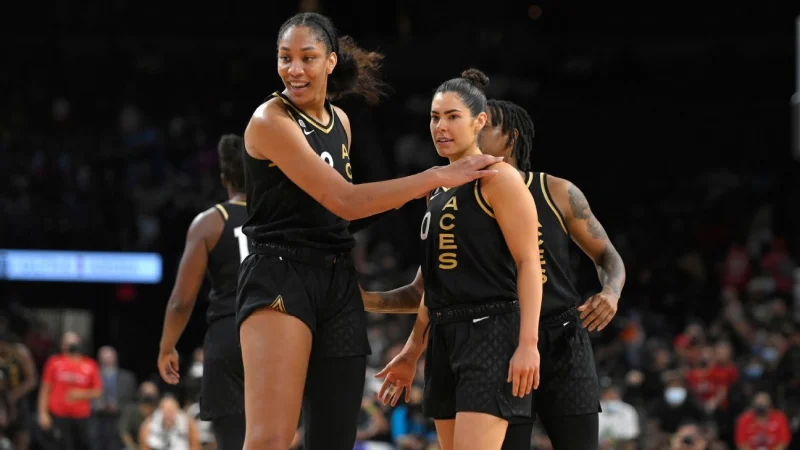
The FIBA Women's Basketball World Cup starts Friday, Sept. 4, in Berlin, Germany, and the U.S. women walk in without A’ja Wilson, the player long described as the greatest on the planet. Their first opponent is China, the 2022 silver medalist, in a game that immediately shows how much of the American margin remains.
That is why the tournament is getting so much attention before the first tip. The U.S. women have won eight consecutive Olympic gold medals and nine of the last 12 World Cups, and their last loss at either event came in 2006. Even so, this is not a field built for a comfortable march. The world has narrowed the gap, and the opening round already puts the Americans against a team that has lived deep into the bracket before.
Breanna Stewart captured the mood before Paris when she said there was “a ton of parity,” and that the U.S. had to be on its “Ps and Qs.” That warning did not come from nowhere. At the Paris Olympics, the Americans needed a defensive play from Stewart and two free throws from Wilson to beat France in the final. Six months before that, they escaped Belgium at the Olympic qualifying tournament on a last-second basket by Stewart. Those games were reminders that the U.S. can still win when it is pressed, but the wins no longer arrive with the same ease.
The roster around Stewart is also being tested in a different way. Sonia Citron and Kiki Iriafen were added to the 2026 USA Basketball Women’s National Team Roster, a sign that the pipeline remains active, but the World Cup is still the immediate measuring stick. With Wilson unavailable, the U.S. will have to replace a player who often changes the shape of a game on both ends. That means the burden shifts to structure, depth and execution, not just star power.
The broader backdrop makes the stakes even clearer. International teams now come in with more WNBA and U.S. college experience, and several have already shown they can stretch the Americans. France’s Olympic team, led by Gabby Williams, pushed the U.S. in the final. Germany reached the Olympic quarterfinals in its first Olympic appearance behind Satou, Nyara, Leonie Fiebich and Alexis Peterson. Nigeria became the first team from Africa, men’s or women’s, to reach the Olympic quarterfinals, with Ezinne Kalu carrying the scoring load and Rena Wakama on the sideline. This is the field the U.S. now has to navigate.
So the first game in Berlin is more than a curtain raiser. It is the first answer to the question that hangs over this team: can the U.S. still look like the clear class of the world when its best player is out and the rest of the world has learned how to make it work for everything?