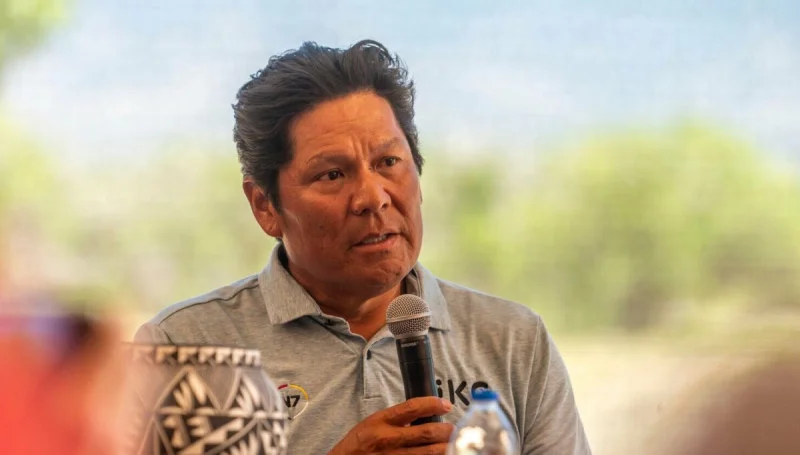
Notah Begay III is being honored with the 2026 Payne Stewart Award, a recognition that turns his life in golf toward the work that has defined his years off the course. The honor lands as the Notah Begay III Foundation marks its 21st anniversary.
For Begay, the search interest now is tied to more than a trophy or a broadcaster’s profile. He was the first full-blooded Native American to play on the PGA Tour, won four times in a 10-month span, and later built a foundation whose mission is rooted in health, wellness, leadership and opportunity for Native American children. Golf is part of that vehicle, but it has never been the destination.
The charitable record behind the award is measured in years, not slogans. Begay’s foundation has spent more than two decades pushing into communities that are too often left with fewer resources and fewer chances. That work fits the spirit of the Payne Stewart Award, which is reserved for character and service as much as competitive success, and it gives the honor a weight that goes beyond what he once did with a club in his hand.

That career, though, never moved in a straight line. Begay’s best golf came before a series of setbacks that included an arrest for drunken driving, injuries that ended the career he had built and depression that made the game feel less like a calling than a source of pain. He has not hidden that history. He has said he was always going to be a de facto spokesperson for the American Indian people, and that responsibility has shaped the way he has spoken about success, failure and what it means to be seen.
Begay’s path to that role began long before the PGA Tour. He grew up in a home beside the 14th green at Ladera Golf Course, where Don Zamora was the longtime director of golf, and worked summers there from age nine to 17 opening the pro shop and practicing and playing. By the time he was 14, he had won the Junior World Golf Championships in San Diego, and later he earned a golf scholarship to Stanford, the first in his family to go to college. At 17, when he was asked to speak to a graduating class of roughly 15 students at To’Hajiilee High School on the Navajo Nation, he wondered what he could offer them because he felt he was in the same boat they were in.
The award now puts Begay’s charitable legacy in the foreground, not the pain that shadowed his playing career. What remains unanswered is the exact form of the formal presentation, but the reason for the honor is already clear: he turned a life shaped by achievement and hardship into a platform for Native American children who need more than inspiration to move forward.