


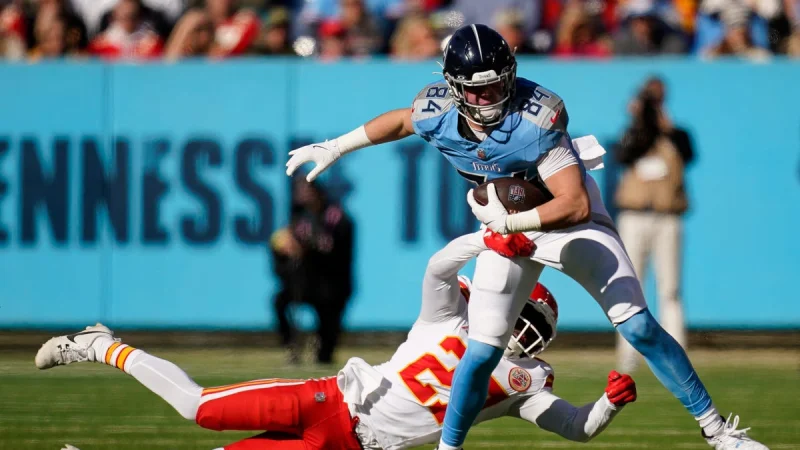
Quentin Johnston has become a dark-horse fantasy football WR1 candidate, and he is doing it while being drafted outside the top 36 wide receivers. The case is simple enough to matter: if the Chargers keep their current receiver plan intact, Johnston could move into far more volume than his draft cost suggests.
That is why his name is coming up now. Fantasy drafts are being shaped by players whose average draft position lags behind their upside, and Johnston fits that hunt for a late payoff. Ladd McConkey is still viewed as the safer Chargers target, but Johnston’s path is about opportunity, not safety. Dan Graziano reported that the Chargers are not expected to sign a veteran receiver before the start of the season, which keeps the door open for Johnston to see more routes and more targets in a depth chart that already leans heavily on McConkey.
McConkey’s role explains the appeal and the ceiling at the same time. He had a near-30% target share down the stretch of his rookie season, but that number was slashed when Keenan Allen was in town last year. If no veteran arrives, the ball has to go somewhere, and Johnston is the wideout most likely to profit from that absence. In fantasy football terms, that kind of vacancy matters more than a familiar name on the depth chart.
The Packers create a similar value conversation, and that is where Jayden Reed enters the picture. The team lost Romeo Doubs and Dontayvion Wicks this offseason, leaving 131 targets up for grabs, and it still finished fourth in EPA per play and third in EPA per pass attempt last season. Christian Watson is the preferred fantasy target for most players because he was WR29 by ADP and ranked fifth among receivers with at least 150 routes in yards per route run, but Reed brings the cheaper price. He was WR47 in the ADP tool, finished WR26 in 0.5-PPR scoring in 2024-25, and was WR23 in per-game scoring the year before that.
That gap between price and payoff is the friction point in the Packers’ receiver room. Watson has the higher ceiling, yet Reed’s injury-shortened season keeps him discounted even though he was limited to seven games and reportedly took some first-team reps in two-receiver sets during training camp. For drafters, that creates a clean split: Watson is the favorite, Reed is the cheaper bet, and both can fit if the offense keeps feeding available targets. The same logic applies to Johnston in the Chargers’ attack, where volume, not reputation, is the reason he can still reach WR1 territory. If the Chargers stick with their current plan, his route count and target share should rise enough to make him one of the few wideouts outside the top 36 with a believable path to a top finish.
