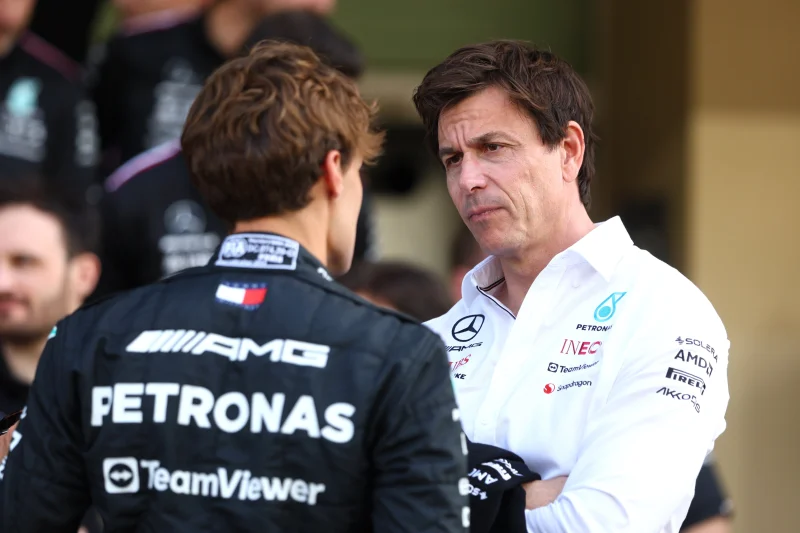
Toto Wolff has drawn a line under the idea of letting Mercedes drift into another driver war. After a difficult Hungarian Grand Prix weekend, he said he would not allow a repeat of the sort of toxic intra-team battle the team lived through before, and that one driver would be dropped if it came to that.
The warning landed at a moment when Mercedes is still leading both championships, which is what makes it sharper. George Russell had to fight through the field from the back after a faulty start procedure from his W17, and Wolff told Sky F1 the team had a problem screwing up George’s start. He called it not acceptable and not good enough, then added that the team would still take a solid gap in the drivers’ championship and a good gap in the constructors’ championship into the 2025 summer break.
That gap matters. Mercedes lead Ferrari by 72 points in the constructors’ standings and McLaren by 159, while Kimi Antonelli sits 50 points ahead of Lewis Hamilton and 59 ahead of his teammate. Yet Wolff was not talking like a man protecting a comfortable position. He was talking like someone who remembers how quickly an apparently manageable pairing can turn poisonous when the pressure starts building from within.
That memory is not abstract. Between 2013 and 2016, Wolff lived through the Hamilton-Rosberg fight inside Mercedes, a battle that was intense enough to shape how he speaks about team order years later. Asked in Hungary about how he would cope with another toxic intra-team battle, he did not hedge. He said, “I will not allow it,” and added, “That’s never going to happen to me again.”
There is a reason the warning carried more weight than a routine summer-break quote. Max Verstappen closed a 104-point deficit to the championship leader at the 2025 summer break and still ended up losing by two points to Lando Norris in Abu Dhabi, a reminder that a points lead can vanish faster than it looks on paper. Mercedes may be ahead now, but Wolff’s comments make clear that a future Verstappen-style pairing would be judged not only on speed, but on whether it could be controlled.
For now, the unanswered part is the most important one. Wolff has said he would act, even if that meant sacrificing one of his drivers, but he has not said which one. That leaves Mercedes with a clear rule and an open decision: the team will not accept another civil war, and if one starts to form, the cost will be immediate.