


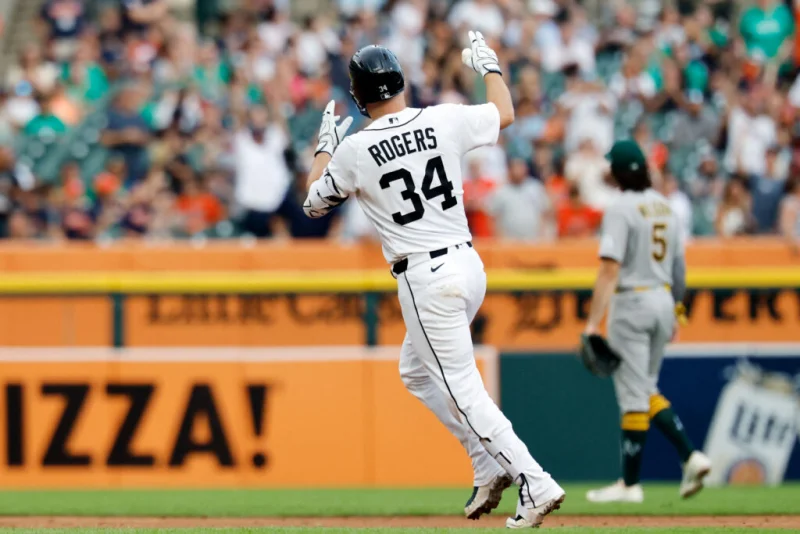
The Detroit Tigers designated Jake Rogers for assignment on Monday night, clearing room after Javier Báez was reinstated from the 60-day injured list. The move came after an 8-5 loss to the Baltimore Orioles and ended Rogers’ immediate run as Detroit’s backup catcher.
For Rogers, the timing cuts deep because this was not a marginal call on a player who had just arrived. He had been with the organization since 2017, came over in the Justin Verlander trade with the Houston Astros, and had appeared in 362 games across six seasons. A.J. Hinch and Scott Harris met with him Monday night and told him what was coming, a conversation that had the feel of an ending even if the baseball part of it is not over yet.
That is why the name is drawing attention now. Rogers has been part of the Tigers’ recent identity in ways that do not always show up in the box score. He handled the bulk of catching duty in 2023 and 2024, played 209 of his 362 games in those two seasons and had his best offensive year in 2023, when he hit 21 home runs with a league-average.730 OPS. He also caught Tarik Skubal as the left-hander rose into a two-time American League Cy Young winner, and he was the player who coined the line, “don’t let the Tigers get hot,” during the 2024 run.
But the Tigers are moving on because they believe the roster spot has to produce more than sentiment. Hinch said the club wanted to maximize the spot as best it could, acknowledged that Rogers would admit the offense has not been easy, and framed the decision as one where two things can exist at the same time. In other words, a player can be beloved by teammates, coaches and fans and still be the wrong fit for a roster that has to squeeze value out of every spot.
That logic explains why Eduardo Valencia is taking over behind Dillon Dingler. Valencia was recalled from Triple-A Toledo on Monday as the replacement for the injured Kerry Carpenter, and the Tigers now expect him to serve as the backup catcher. The club believes Valencia can do a better job of maximizing the roster spot moving forward, especially as a hitter, even if the defensive side of the job is not the story here.
What happens next is straightforward under the rules and harsh in practice. Because Rogers has more than five years of MLB service time, he cannot simply be pushed through outright waivers. The Tigers have a seven-day window to trade him. If another team claims him off waivers, that club must add him to its roster. If Detroit cannot work out a trade and no team claims him, Rogers will become a free agent. For a player who hit.161 with two home runs and six RBIs in 110 plate appearances this season, Monday night was not just a roster transaction. It was the start of a short clock on the next phase of his career.
