


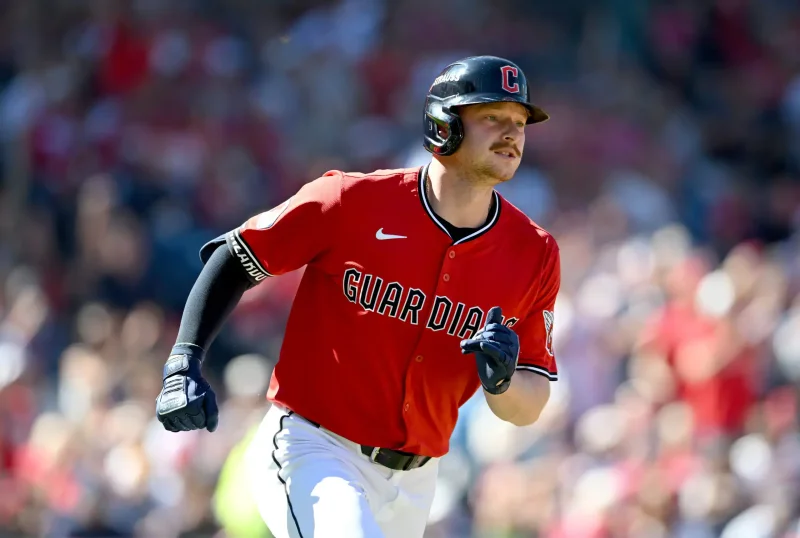
Kyle Manzardo’s 2026 season has not matched the power he showed a year ago, but the numbers underneath the slump do not read like a hitter who has been solved. He has 11 home runs after hitting 27 in 2025, and his overall production has slid to a 90 wRC+ from 113.
That dip is why Manzardo is being searched now: after a very slow start, he ran through a blazing 6-7 week stretch, then cooled again, leaving a season that has felt hot and cold by the week. The surface result is disappointing, but the path to it is more complicated than a simple loss of form.
His approach metrics have mostly moved the right way. His Whiff% is trending down, his K% is moving down and his BB% is up, even though that walk rate was only 8.9% during the slow start. In other words, he is not just flailing more often or chasing his way into trouble. The swing decisions are not the easiest place to blame for the drop in results.

The contact quality story is messier, and that is where the friction sits. Manzardo’s average exit velocity is described as pretty stable across the board, yet his Hard-Hit% and Barrel% have swung around anyway. That makes sense when you look at the bands around the contact: his LASS% has moved wildly, he is getting fewer balls in the optimal 8-32 launch angle range, and his contact in the 90-94.9 mph exit velocity range has gone from 19.6% to 12.2% and then back up to 19.6%. He is also just missing the 95 mph Hard-Hit% threshold a bit more now than he was during the hot streak.
There is still a thread of bad fortune in the recent stretch. Manzardo’s most recent run shows a wOBA and xwOBA gap of -.076, with xwOBA at.276, which is still well below what would be expected from a productive bat. That does not erase the slump, but it does argue against a clean conclusion that the league has completely changed the book on him. For now, the better read is that a young MLB hitter is dealing with uneven outcomes while the underlying shape of his game remains alive.
What happens next is the part that will define the rest of his year: whether those stable or improving approach numbers finally turn back into power, or whether the disappointing 2026 line keeps dragging the evaluation toward a harder question about how much ceiling is left in the bat.
