


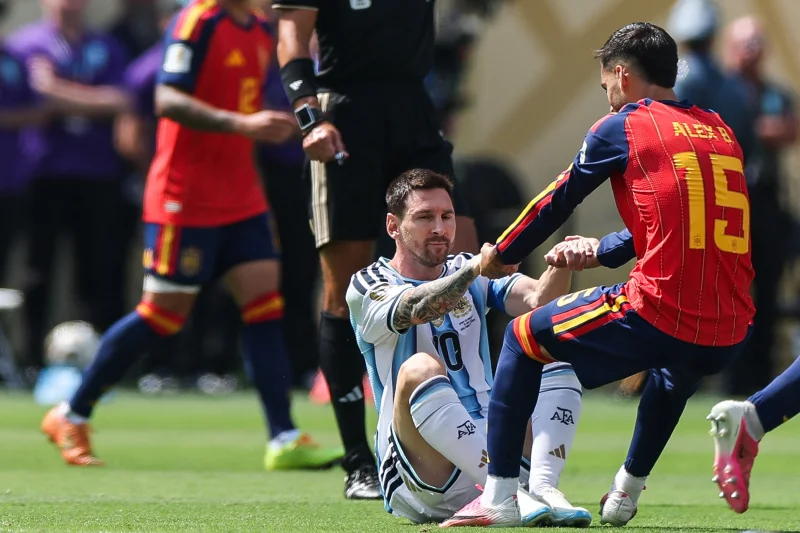
Lionel Messi would be 43 years old at the 2030 FIFA World Cup, a number that turns a routine age check into a real question about whether he could still be on the field when the tournament reaches its 100-year mark. He was born on June 24, 1987, and will be 43 in 2030.
That is why fans keep asking how old is Messi now, and what that means for the next World Cup. He arrived at the 2026 World Cup at 39, still central to Argentina, while his current contract with Inter Miami runs until December 2028, when he will be 41. The timeline leaves a door open on paper, even if it does not answer it.
The stakes around the 2030 tournament help explain the interest. It will be the 24th edition of the World Cup and comes in the centenary year of the first one, played in 1930. The first three matches will be in Uruguay, Argentina and Paraguay, which adds a South American layer to a tournament FIFA has otherwise spread across Spain, Portugal and Morocco.

Messi’s age stands out because very few players reach the World Cup after turning 40. Cristiano Ronaldo did so in 2026 and played his last match at 41 years, 4 months and 18 days old, in a round-of-16 loss to Spain. That gives a hard reference point for what a player can still do at that age, but it does not make the path any simpler for Messi.
There is also a direct brake on the fantasy. After Argentina’s first match in the 2026 World Cup, Messi was asked about a possible seventh World Cup and answered, “No, eso no.” It was a short reply, but it cut against the fan logic built from his age, his form and the length of his contract. Messi has already passed Miroslav Klose as the World Cup’s top scorer and become the player with the most matches in the tournament, so the record book itself is not the obstacle. Time is.
That is the unresolved point now. Messi could still be under contract through the end of 2028 and only 41 when it expires, but 2030 would ask for two more years beyond that and a body that has already carried him through multiple World Cups. The math says he would be 43. His answer so far says he is not planning around that number.
David Beckham put Messi’s late-career scale in blunt terms, saying he could not call him the greatest ever without thinking of Pelé and Maradona, but called him one of the greatest in history and said his career was not over because he would keep playing. The next step is not a new milestone. It is whether Messi’s own refusal in 2026 holds, or whether the centenary World Cup becomes the last stage that could still pull him back.
