


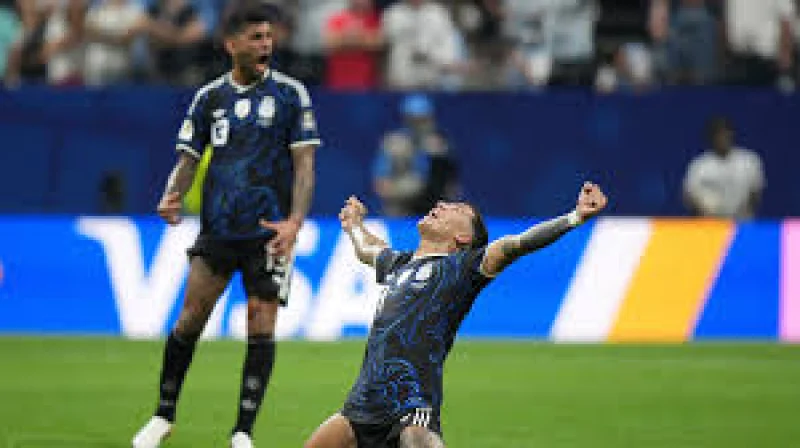
Argentina players may still face FIFA action after a large group of them celebrated Wednesday’s 2-1 World Cup semifinal win over England with a banner reading “Las Malvinas son Argentinas.” By Sunday morning, hours before kickoff against Spain, the governing body had not announced any punishment, leaving the team’s final-day squad plans under a cloud.
The banner translated as “The Falklands are Argentine,” and it pushed a familiar territorial dispute back into football’s center stage. The slogan points to the Falkland Islands, about 300 miles off the southernmost tip of Argentina, where the dispute erupted into violence in the Falklands War of 1982. That 74-day conflict killed 255 British soldiers, 649 Argentines and three island residents, and the symbolism of the banner was clear enough that Keir Starmer backed calls for a FIFA investigation while Ed Davey said the players should be barred from Sunday’s final against Spain.
FIFA’s response so far has been cautious. A spokesperson said the disciplinary committee was assessing the match reports and considering the relevant circumstances before deciding on any further steps under the FIFA disciplinary code. The rules are not subtle: Article 34.3 of FIFA’s 2026 World Cup regulations prohibits political messages or slogans before, during or after a match. That matters because a celebration that looks, to fans in Buenos Aires, like national pride can look, to football’s disciplinarians, like a political statement on the pitch.
The dispute has also exposed the old split between how Argentina sees the banner and how its critics do. Javier Milei called the players’ expression “perfectly valid” and said, “A football match is a football match.” Victoria Villarruel went further, saying, “The Falklands are Argentinian!” and adding, “They banned bringing them to the stadium and forgot that we carry them in our blood and our hearts.” On the other side, Peter Kyle told the that the World Cup’s central tenet is that politics is separate from football and said he expected FIFA to investigate thoroughly because it was such an egregious violation of the rules. The White House, as reported by Rob Harris, backed the players’ right to protest about the Falklands at World Cup matches, while Andrew Giuliani framed the issue as first amendment rights on freedom of expression.
The closest precedent is awkward for Argentina. In 2024, Rodri and Álvaro Morata were banned for one match each after chanting “Gibraltar is Spanish” during Spain’s European Championship celebrations. That case showed FIFA is willing to punish political slogans even when they come in celebration, not protest. Argentina was expected to have its full roster available for Sunday’s final at 3 p.m. ET at MetLife Stadium in New Jersey, but the unresolved question was whether FIFA would treat the banner as protected celebration or a sanctionable breach before the match started.
England had already beaten France in Saturday’s third-place match, and the sequence left FIFA with little room to wait. By the time the final began, the organization had to decide whether the banner was just another burst of postgame nationalism or a direct violation of its own rules. For Argentina, the issue is no longer what the players meant by it. It is whether the governing body agrees before the trophy is lifted.
