


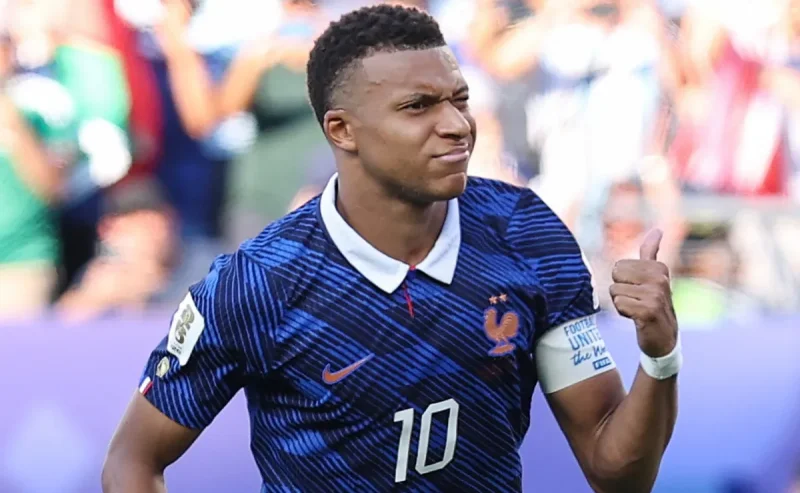
Kylian Mbappe will be 31 years old when the 2030 FIFA World Cup begins, a figure that answers the question behind the current surge in searches about his future. If France selects him, the tournament would likely be his fourth World Cup appearance, a rare arc for a player who first arrived on the sport’s biggest stage as a 19-year-old in Russia 2018.
That matters now because Mbappe is not being discussed as a fading name; he is still being framed as a France leader years before the next tournament. His age in 2030 puts him in a bracket where elite forwards can still decide matches, even if the physical margin is slimmer than it was at 19. The same projection puts Ousmane Dembélé at 33, while Mike Maignan and Adrien Rabiot would each be 35, which suggests France could enter that cycle with an unusually seasoned core.

Mbappe’s age also gives the number more meaning than a simple birthday count. He helped France lift the trophy in Russia 2018, then watched France’s 2026 World Cup campaign end with a semifinal defeat to Spain. By 2030, the question is not whether he has already done enough on the international stage. It is whether he can still be the player France trusts when the tournament opens across Spain, Portugal, Morocco, Uruguay, Argentina and Paraguay.
There is, however, a gap between projection and reality. Being 31 in 2030 does not guarantee selection, and it does not guarantee health. Mbappe is expected to remain central to France’s plans, but the final call will depend on form and fitness when the squad is actually chosen. That is what keeps the answer alive: he should be old enough to matter, but old enough also to be judged like everyone else.
For now, the cleanest answer is the one readers came looking for. Mbappe will be 31 during the 2030 FIFA World Cup, and if he is there, it would almost certainly be as a veteran of three previous tournaments, not as the teenager who burst onto the scene in Russia 2018.
