


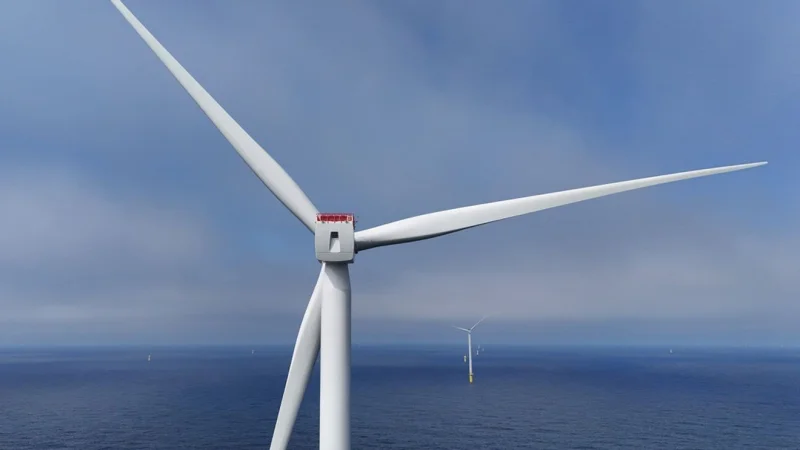
President Donald Trump’s administration has spent months trying to stop offshore wind power, arguing that the industry poses a national security risk. The push has continued since late last year, even as major projects remained visible offshore and at staging sites.
That matters now because the fight is not abstract. On April 23, 2026, a wind turbine base and turbines were visible at Sunrise Wind offshore wind farm off the coast of Montauk Point, New York, while a vessel sat nearby. On the same day, the Revolution Wind central hub or substation was visible off the coast of Rhode Island. Farther south, wind turbine bases, generators and blades were sitting with support ships at The Portsmouth Marine terminal in Portsmouth, Va., on Dec. 22, 2025.

The administration’s argument is simple on its face: offshore wind facilities are being treated as a threat to national security. The images point to the scale of what is at stake. Sunrise Wind, Coastal Virginia Offshore Wind and Revolution Wind are all being developed while the federal effort to halt the sector continues, and the equipment already in place shows how far along some of that work had gone by the time the opposition hardened.
That is also where the friction lies. The same construction that gives the administration a target is also evidence that the projects are not just plans on paper. At The Portsmouth Marine terminal, Dominion Energy Virginia was using the site as a staging area for Coastal Virginia Offshore Wind, with turbine bases, generators and blades already assembled with support ships. Offshore wind power is moving ahead in visible pieces even as Washington works to slow it down.
What happens next is still the open question. The administration has not laid out in the material here which specific permits, projects or decisions will be the next target, but the direction is clear: the effort to stop offshore wind development is ongoing, and the projects offshore New York, Virginia and Rhode Island remain in its path.
