


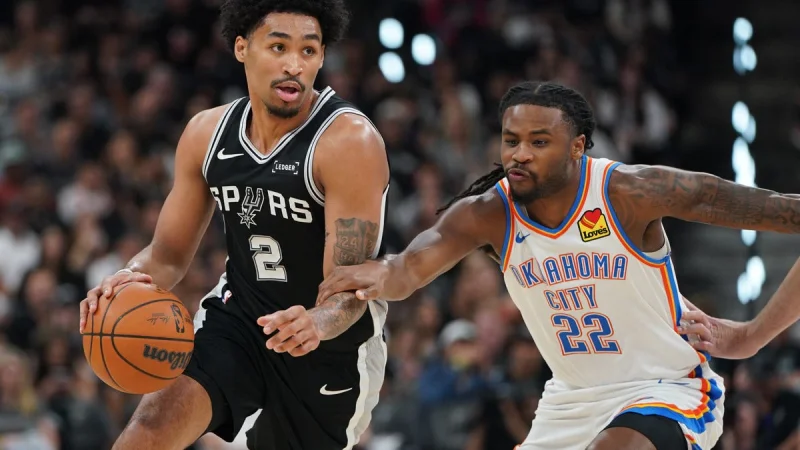
Heavy.com has put Dylan Harper in the center of a six-player blockbuster, proposing a deal that would send the San Antonio Spurs guard to the Los Angeles Lakers. The framework would move Jaden Hardy, Jake LaRavia, Dalton Knecht, Adou Thiero, Cameron Carr, a 2032 first-round pick and a 2033 second-round pick to San Antonio.
The reason this turns heads now is simple: Harper is still on a rookie scale deal worth $12.9 million a year, and he already looks like a guard worth building around. The 2025 No. 2 overall pick averaged 11.8 points, 3.4 rebounds and 3.9 assists in 69 games as a rookie, started only four of them, and still made the NBA All-Rookie First Team. He also helped the franchise reach the NBA Finals, then scored 25 points in the series climax against the New York Knicks. That kind of production on a cheap contract is exactly why a trade proposal like this gets attention.
It also explains why the Lakers keep coming up in these discussions. They already have a strong guard core from Luka Doncic to Austin Reaves, and Reaves has already been extended to a new improved long term deal. In that setting, Harper would not be arriving to carry the offense alone. He would be sliding next to high-usage creators, which is the kind of role that can simplify his reads, cut down on self-creation pressure and let his scoring and passing play off elite ball handlers.
That is where the idea starts to collide with reality. The package is big enough to look serious, but the odds of the Spurs moving Harper are still described as slim. He has played only one year, he is entering his second, and his rookie year already showed why San Antonio would have reason to keep him: he was productive, efficient enough to matter, and good enough to earn immediate recognition. A player like that is usually the sort teams try to add around, not move out of a young core.
So the proposal says more about the market for Harper than about an imminent deal. The Lakers can be linked to him because he fits their guard structure and because his rookie contract gives any acquiring team cost control. The real question is whether San Antonio would ever turn that into an actual conversation. On the evidence now, the answer looks like no — and that is what makes the proposal more revealing than realistic.
