


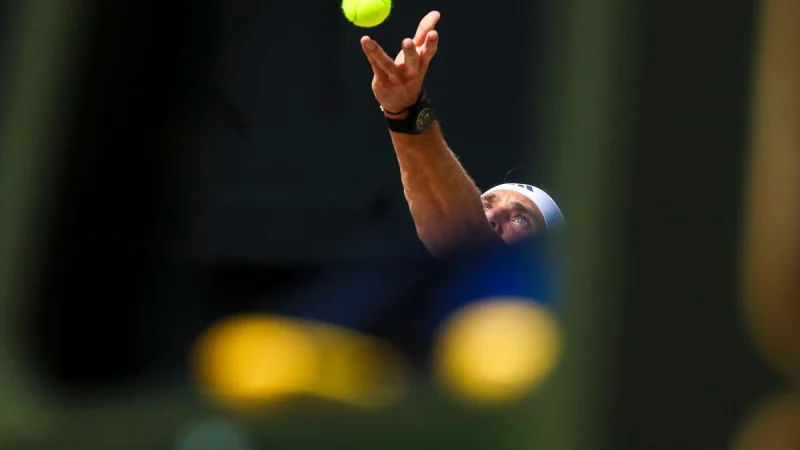
television coverage of Wimbledon put Alexander Zverev front and centre this fortnight, but it did not discuss the abuse allegations attached to his public profile. The German, the second seed, was due to play Jannik Sinner in his first-ever Wimbledon final on Sunday afternoon, and the coverage around him moved forward without that part of the story.
That mattered because Zverev was not being treated as a marginal player drifting through the draw. He was one of the tournament’s main figures, and British viewers seeing him on TV were being shown a polished sporting narrative at the very moment he was heading into the biggest match of his grass-court career. The coverage of Zverev at Wimbledon did not, to the author’s knowledge, raise the allegations made against him by Olya Sharypova and Brenda Patea.
Those allegations are not ancient or obscure. In 2020, Zverev was accused of physical and emotional abuse by Sharypova. He denied the claims, and the ATP commissioned a major independent investigation that concluded in January 2023 there was insufficient evidence to substantiate published allegations of abuse. In 2023, Patea made similar accusations, which Zverev again denied. Her case went to German authorities and ended in a 2024 settlement that required him to pay 200,000 euros in penalties.
The court said that result was not a verdict and not a decision about guilt or innocence, but it still left the allegations sitting in the public record while Wimbledon viewers heard something else. For its introduction to Zverev’s first-round match, the panel of Clare Balding, Tim Henman, Jamie Murray and Anne Keothavong talked about his French Open win after three Grand Slam finals defeats, an ankle injury from four years ago and his second serve return position on grass last year. None of that was false. It was simply the safer, cleaner version of who he is.
That choice is what stands out. The broadcaster had no trouble presenting Zverev as a star whose career arc was worth unpacking in detail, but it appears to have drawn a line at the part of that arc that is most uncomfortable. The allegations are not a footnote in his profile; they are part of the reason any serious introduction to him comes with more weight than serve percentages and injury updates. The article says the cases take up 11 paragraphs of his English-language Wikipedia page, which is a blunt measure of how central they have become to the story around him.
So the question hanging over television coverage is not whether Zverev merited attention at Wimbledon. He clearly did. It is why the broadcast chose to frame him as a champion in waiting while leaving out the allegations that follow him onto every major stage. If that pattern holds, viewers in Britain who rely on Wimbledon for their tennis are still being given only part of the picture.
