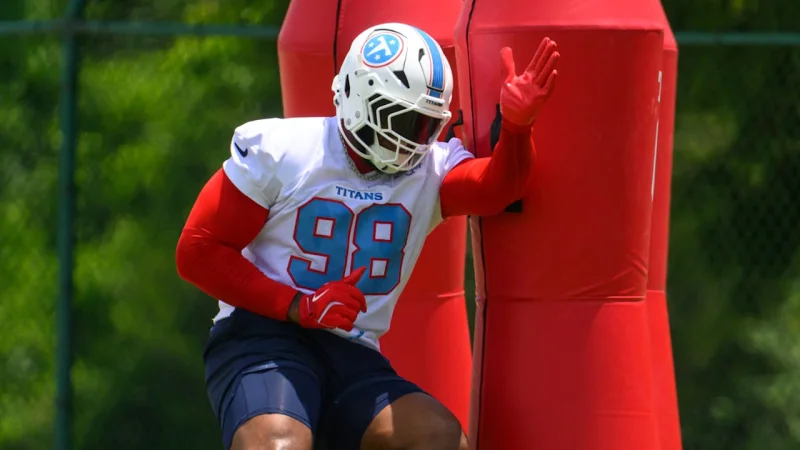
Robert Saleh is changing how the Tennessee Titans will use Jeffery Simmons, and the change is aimed at the moments that decide games. Instead of leaving the interior rusher on the field for the kind of snap load he has carried before, the Titans plan to use a rotation so he is fresher when third down and two-minute situations arrive.
The move matters now because Simmons is not just another starter. The Titans gave him a three-year, $105.8 million extension this offseason, with $100 million guaranteed, making him one of the most expensive interior defenders in the game at an average of $35.276 million per year. Chris Jones is the only interior rusher above him, at $31.75 million a year.
Simmons has earned that contract with production that still jumps off the page. Per Next Gen Stats, he finished last season with 60 QB pressures, a 13.9% pressure rate and 11 sacks. He also led all interior defenders with 26 quick pressures and a 6% quick QB pressure rate, which is the kind of impact the Titans want preserved for the highest-leverage snaps.
That is where Saleh's plan gets specific. He said the point of the rotation is to make sure Simmons is ready for the one-on-one matchups that matter most, and he added that the goal is to keep him fresh, ready to roll and able to empty the tank when the game tightens. In his view, if Simmons is out there for 50 plays out of 60, the Titans are not using him correctly.
But Simmons is not signing up to disappear into a reduced role. During minicamp, he said he wants to show he can handle more work and that he wants the mindset of telling his coach he can go for more. He said the way he trains and prepares his body should let him prove he can go six plays instead of the four the staff is talking about.
There is also a football reason behind the change. In Saleh's scheme, Simmons is expected to attack more readily than he did in the two-gap defenses he played in before, where the job often meant holding ground and absorbing double teams at the line of scrimmage. The new approach asks interior defenders to get upfield and disrupt, which is exactly the kind of job that can make a pass rusher more dangerous if he is fresh late in the down.
The catch is that Simmons has been built for volume for years. He has played at least 80% of defensive snaps per season when available dating back to 2020, and in every season in which he played at least 15 games he also logged at least 750-plus snaps. That history is why the Titans' plan is not just about preservation; it is about changing a player's workload while asking him to stay as disruptive as ever.
Saleh said last month that he still had not had a sit-down meeting with Simmons about the rep plan, which leaves the real test for later. The question now is not whether the Titans value Simmons. It is whether they can trim his load without pulling back the pressure he brings when the game is on the line.