


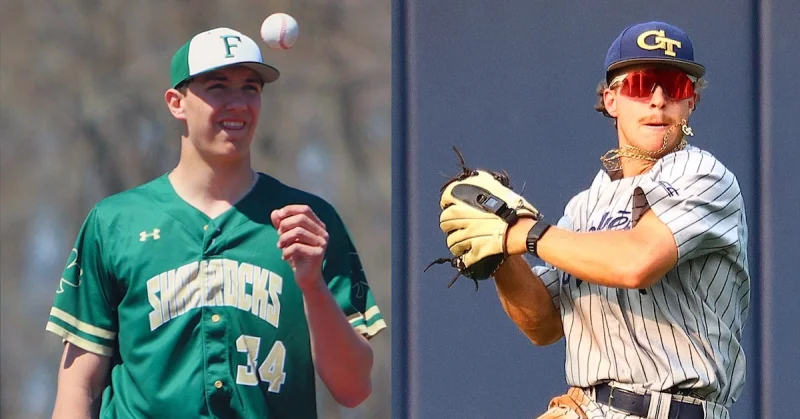
Coleman Borthwick arrived at the MLB Draft Combine as the kind of prospect teams notice before he even throws a pitch: 6-foot-6, listed at 245 or 255 pounds, and already carrying the kind of arm action that can put a fastball in the high 90s. The Florida high school two-way player had already finished 10 team interviews and still had 14 more scheduled for Wednesday, a sign that the questions around him are coming as fast as the velocity.
That attention is no mystery. Borthwick, 18, was the MVP of the WSBC U-18 World Cup last fall after hitting.300 and throwing a three-hit shutout against Japan in the final. He said the conversations with clubs have been easier than he expected. “It was a lot easier than I thought,” he said, adding, “Everybody’s stressed out about it. Dude, I’m a talker, so I ain’t worried. I have a good personality, so I just… go with the flow.”
What makes him unusual is not just that he can hit and pitch. It is that he has already looked the part of a pro body, which changes the draft conversation before it begins. High school pitchers are often sold on future growth, but Borthwick is being evaluated with less guesswork than most. He is already big. He is already strong. The puzzle is not whether he can add physicality; it is how teams judge the ceiling of a player who has, in some ways, already filled out.
Even so, the arm gives evaluators a reason to keep leaning in. Against Japan, his fastball sat in the low 90s, and as a senior it has flirted with 97 to 98 mph. He also has a potential plus slider and a compact, drop-and-drive delivery that can help explain why his size does not make him look stiff on the mound. A bigger pitcher does not automatically mean a better pitcher; the concern is usually whether the delivery stays efficient enough to repeat. Borthwick’s action is built to stay short, as he put it, “like an infield throw,” which is part of why the velocity can still play cleanly.
That is where the draft decision gets tricky. Borthwick’s frame makes him hard to project in the usual sense because he already appears projected. The same size that creates confidence can also narrow the argument for upside, at least in the traditional sense teams use with high school arms. He has long worked as an athletic player in the field, and he said his father, the baseball coach at his high school, had him practicing after the school bus dropped him off every day, with work at shortstop and center field to keep the arm active. The result is a prospect who does not fit neatly into one box, even after a World Cup run that put him on the map.
By the time the interviews are done, clubs will have a clear picture of what they think they are buying: a pitcher with premium velocity, a hitter with a record of success on a big stage, or a two-way athlete whose body and arm both look advanced for 18. What they still have to decide is whether Coleman Borthwick’s rare size is the start of more room to grow or the point where the growth story has already reached its final chapter.
