


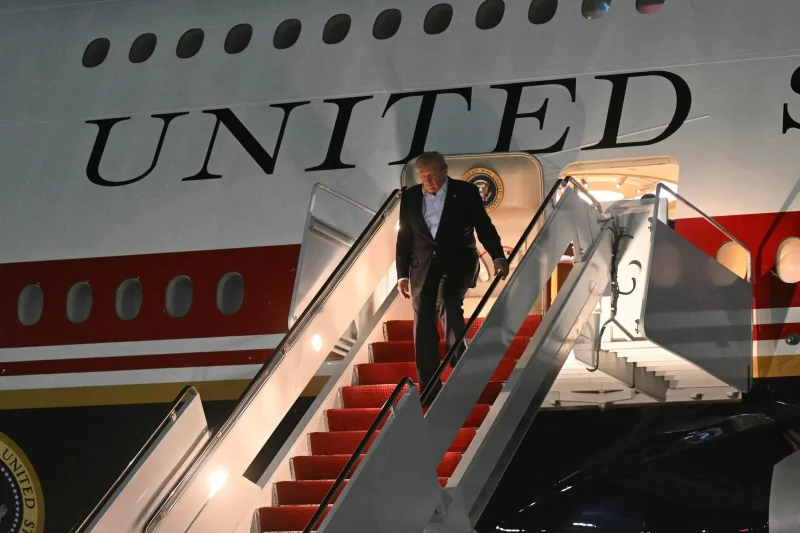
The White House has grounded President Donald Trump’s new Air Force One jet gifted by Qatar earlier this week, halting its use over concerns that the plane still lacks proper security capabilities. Trump had already flown part of the way home on the older Air Force One after the jet’s first international trip to Turkey.
The move lands at a moment when the aircraft has suddenly become part of the broader fight over Trump’s security. He told reporters in Ankara that he is “number one on the kill list for Iran,” and the older plane was used on the return because of renewed concern about threats tied to Iran. The switch also came after the United States received intelligence from Israel that Iran was plotting to assassinate him, according to a report citing officials.
Steven Cheung said the jet gifted to Trump by Qatar last year has been fitted with high-level security protocols that ensure the safety of the president and his staff. He said there are many enemies of America who have their sights on Trump. But the fact that the plane has now been grounded points to a different reality: whatever protections are in place, they have not been enough to put the aircraft into regular use while the review and upgrade work continues.

The Air Force began security upgrades to the jet in September and has described the project only as work to modify the plane for executive airlift support. Everything else is classified. That leaves the central question unanswered for now: which exact capabilities were already installed, and which were still missing when the grounding decision was made? Aviation experts have said the renovation could involve checking for listening devices or spyware, adding secure communications, missile defense, midair refueling and protection against electromagnetic attacks, along with space for White House medical staff and the Secret Service.
The scope of the work also helps explain why the plan has drawn so much scrutiny. Troy E. Meink told Congress last year that the upgrades would probably cost less than $400 million, while some aviation experts and Democratic lawmakers have put the figure closer to $1 billion. Andrew P. Hunter told that some of the more complex security work would involve advanced missile defense systems and wiring hardened against a nuclear blast. Richard Aboulafia said some of the expected renovations, including midair refueling, would be enormously time-consuming and could stretch into the 2030s.
That timetable sits uneasily beside the administration’s plan to donate the plane to Trump’s library foundation in 2029. The Air Force has been working under a classified program for 10 months, yet the upgrade path still appears to be in motion even as the aircraft is being held back from normal presidential use. Trump’s first flight on the jet came last week on a trip to North Dakota, and the plane’s quick turnaround has only sharpened the contrast between the public rollout and the private work needed to make it viable. The next question is not whether the jet will be fixed, but whether the security standard needed to fly it is achievable before the project’s schedule runs into the very decade some experts say it may take.
