


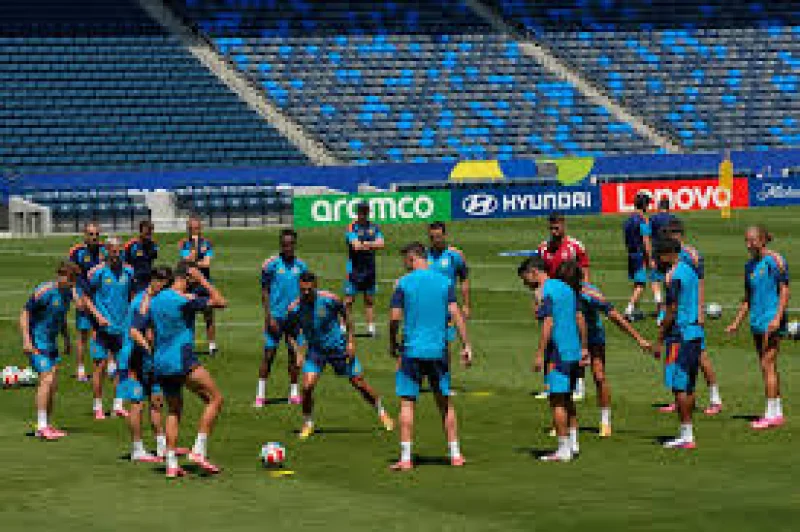
Spain and Belgium met in a World Cup quarterfinal on Friday, July 10, with a place in the semifinals on the line and France waiting next. The match, shown with Russian-language commentary on ETV+ and the Rus.ERR portal, put the winner into a July 14 semifinal against France.
For readers following Spain–Belgium, the pull is obvious: one team arrived unbeaten in five matches and still had not conceded a goal, while the other had already survived a far rougher path through the group stage and knockout rounds. Spain opened with a 0:0 draw against Cabo Verde, then beat Saudi Arabia 4:0 and Uruguay 1:0 before shutting out Austria 3:0 and Portugal 1:0. Belgium’s route was tighter and messier. It drew 1:1 with Egypt, then 0:0 with Iran, beat New Zealand 5:1 to finish first in the group, and had earlier rallied from 0:2 down by the 85th minute against Senegal to win 3:2 after a late penalty in extra time.
That contrast helped define why the quarterfinal mattered beyond the bracket. Spain was the only team at the final tournament not to have conceded after its first five matches, a run that made it look like one of the tournament’s main favorites and the reigning European champion. Belgium, meanwhile, had shown its own stubbornness, beating the United States 4:1 in the round of 16 after barely escaping several matches that could have gone the other way. On the radio side, Iгорь Савельев and Алексей Маргиев were the voices describing all of it for ERR, turning a single knockout date into an event for listeners following the match live.
The result also fit a longer rivalry that has rarely broken Spain’s way in modern years. The teams had met only once in a friendly since the qualifying cycle for the 2010 World Cup, when Spain won 2:0 in 2016. Belgium’s last victories over Spain came in the 1980s: a 2:1 group-stage win at Euro 1980 and a 5:4 penalty shootout after a 1:1 draw in the 1986 World Cup quarterfinal. That is a gap of 30 years between Belgium’s 1986 win and the 2016 friendly, and 40 years between the 1980 European Championship victory and the July 10 quarterfinal.
What happened next was straightforward, even if the path to get there was not: the winner on July 10 was scheduled to face France on July 14. France had already booked its place by beating Morocco 2:0, so the Spain–Belgium quarterfinal did more than settle a single match; it decided who would arrive at the semifinal with one fewer step to the final and with the tournament’s cleanest sheet or its most hard-earned run still very much in view.
