


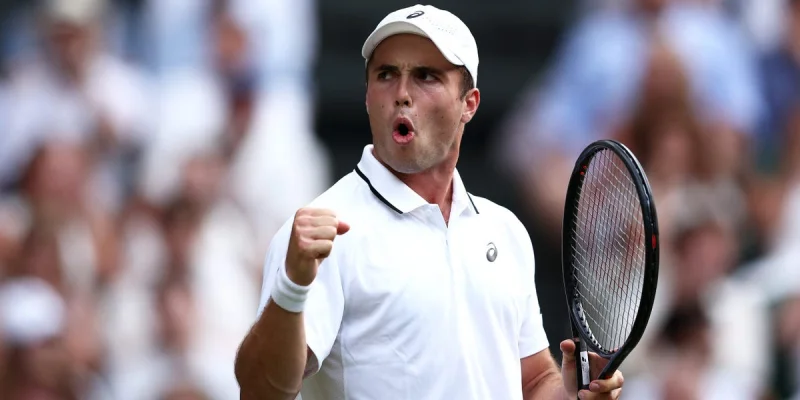
Arthur Fery is one win from a Wimbledon final after the 23-year-old wild card beat the ninth seed, Flavio Cobolli, in straight sets on Wednesday. The result sent Fery into the semifinals and made him the fifth British man to reach that stage at Wimbledon since the Open Era began in 1968.
That is the kind of run that turns a little-known entrant into the name everyone is searching for. Fery came into the tournament with a world ranking of 114th, too low to qualify automatically, yet he has already outlasted players expected to go deeper and now faces Germany's Alexander Zverev on Friday. A win would put him in the Wimbledon final, and one more victory after that would make him the champion.
The numbers around the run are striking, but so is the scale of the player himself. Fery is 5-feet-9 inches tall and depends on perseverance and athleticism rather than reach and serve speed. He has built this breakthrough through movement and stubbornness, not through the physical advantages that often define the modern game.

His success also comes with an unusual backdrop. If Fery loses in the semifinals, he will take home about $1.2 million. If he reaches the final, that rises to about $2.4 million. Winning the tournament would push it to about $4.8 million, a figure that looks enormous in a tennis context but is pocket change compared with his father's fortune.
That fortune belongs to Loïc, whom Challenges lists as France's 402nd-richest man with about 330 million euros, or around $380 million. Loïc started as a financial trader in Hong Kong for Société Générale, set up Chenavari Investment Managers in 2008 and later owned FC Lorient between 2009 and January of this year. Chenavari's website says the firm has $5.8 billion of assets under management.
Fery's route to this point has been built carefully. He attended King's College School, Wimbledon, then enrolled at Stanford University on a tennis scholarship in 2020 and became the top-ranked singles player on the college circuit. Now he is one victory away from something Britain has not seen in years: a man in a Grand Slam singles final.
Beat Zverev, and Fery becomes the first British player to reach a Grand Slam singles final since Andy Murray in 2016. He would also become only the second wild card to do it since Goran Ivanišević won the 2001 championships. For a player who entered Wimbledon outside automatic qualification, Friday is not just the next match. It is the line between an eye-catching run and a place in the sport's history.
