


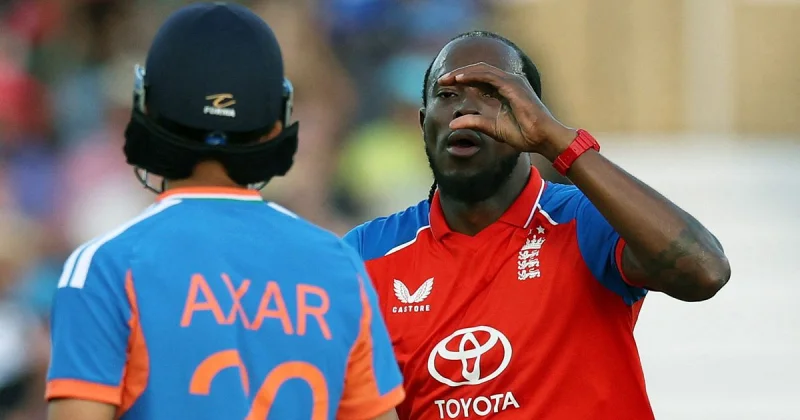
Jofra Archer said bowling in England feels like a return to “normal” after the third T20I in Nottingham, where he and Josh Tongue ripped through India and left the visitors all out for 76 while chasing 202. Archer took 3/29 and Tongue 4/38 as England moved 0-2 ahead and handed India their biggest defeat by runs in the shortest format.
The timing matters because Archer linked the performance directly to conditions, not just speed. He said that at the IPL, sometimes 200 is not safe, but on this wicket a chase of 200 would have needed something special. In his view, English pitches give bowlers a little more margin for error, while “easy wickets and smaller boundaries” in India demand far more precision. That is the comparison drawing attention now, because it came straight after a result that exposed how fragile India’s batting has been since Shreyas Iyer took over the revamped side from Suryakumar Yadav after the World Cup triumph in March.

Archer also pushed back on the idea that raw pace alone decided the game, even though he and Tongue repeatedly went over 144 kmph and shared seven wickets between them. He said the pair bowled well in Manchester too, only without the wickets to show for it, and added that the wind made the ball feel less quick out of the hand than it might have looked on screen. That leaves the more awkward part of the story sitting in the middle of the scorecard: India were not just beaten by speed, but by a spell that combined bounce, length and a pitch that offered enough for bowlers to keep asking the same question.
Vaibhav Sooryavanshi provided one of the clearest threads through the match. The 15-year-old had hit Archer for a first-ball six on his T20I debut in Manchester, but at Trent Bridge Archer sent him back for 13 with a 145 kmph lifter. It was a sharp reminder that cricket can flip quickly from promise to pressure, and that the same bowler who was punished in one match can control the next when conditions tilt his way. For India, the concern is bigger than one dismissal: after being bowled out for 76, they still need to show they can handle a moving target when the ball is hard, the pitch gives help and the margin for error disappears.
England’s lead means the series has already turned into a test of how far India’s new-look T20 side has to go before it can travel away from the flat, high-scoring patterns that Archer described. If the next match brings another surface with carry and bounce, the question will not be whether Archer’s pace was enough. It will be whether India can finally make 200 look safe when the conditions do not.
