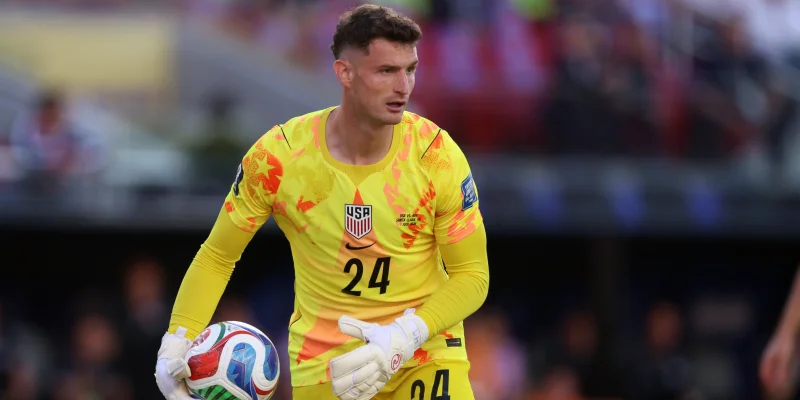
Matt Freese is the starting goalkeeper for the U.S. Men’s National Team at the 2026 World Cup, and the path that put him there runs through Harvard, the Philadelphia Union and a family that expected something very different. He grew up around scientists and doctors, not the usual pipeline for a World Cup starter.
That is why his name is being searched now. Freese’s rise has become one of the more unusual stories attached to the tournament, especially because his father, Andrew Freese, was a neurosurgeon and gene therapy pioneer who helped shape modern medical research long before the current penalty shootout spotlight fell on his son. Andrew Freese served as chief of neurosurgery and neurological medical director at Brandywine Hospital, earned his Ph.D. in neurobiology from Massachusetts Institute of Technology and did research in mRNA technology years before it became central to the COVID vaccine effort.
Andrew Freese also performed the first successful gene therapy surgery to treat a neurological disorder and helped a child with Canavan disease become the longest-living person diagnosed with it. In other words, Matt Freese did not come from a family that treated professional sports as the obvious path. His mother, Marcia Geary Wolicki, holds an MBA in healthcare management and raised four children largely on her own after she and Andrew Freese divorced when Matt was eight. That background mattered when he chose soccer over the more traditional academic route.
Freese left Harvard after two semesters to sign with the Philadelphia Union in Major League Soccer, and he said his father did not see much social altruism in professional sports. Andrew Freese thought it was potentially a selfish career, and Matt Freese later described his own decision as an attempt to balance making his father proud with following his own path. He said Harvard was partly a compromise, not an ending point, and that he was trying to respect both his father’s encouragement and his wishes.
The break did not sever the family connection so much as expose its limits. Freese has said his father was an incredibly intelligent person with the off-the-charts kind of intelligence, and that he had the same brain. He also said Andrew Freese was so talented, hard-working and caring, and that as a doctor he dedicated his life to helping others. Katherine said Andrew Freese obviously came around, and she added that Matt was better than anybody understood.
Andrew Freese died of kidney failure in 2021 at age 61, before Matt Freese finished his degree in 2022 after Harvard began offering online classes during the pandemic. The older Freese never saw his son become a World Cup starter, but the arc is now clear enough: the boy who left campus for a soccer career found his way back to the degree and all the way onto the biggest stage in the sport. The remaining question is not whether he belonged on the roster; it is how far he can carry the U.S. Men’s National Team once the pressure of the 2026 World Cup begins to turn every save into a test.