


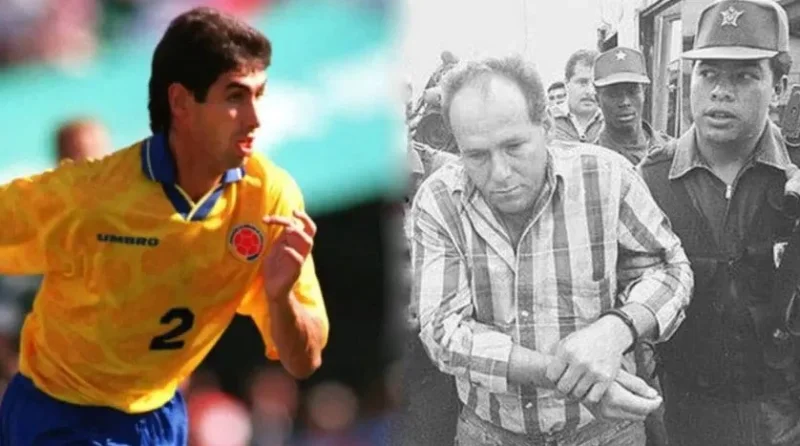
Santiago Escobar says he still cries for Andres Escobar 32 years after the killing that followed the 1994 World Cup, and the memory still opens the same wound. He was jolted awake at 2 a.m. on July 2, 1994, when a telephone rang in Las Vegas, Nevada, and in that moment his brother’s fate began to feel real.
Escobar was there with his father, Dario, and several siblings and extended family, following Colombia in the tournament and planning to tour the United States as they watched the matches. The call came after Andres had returned to Medellín instead of staying with the family, and Santiago still remembers how sudden the news felt after a month in which the family had been living and breathing every game.
What made the loss harder to absorb was how far Andres had already come. He had started every game for Colombia at the 1990 World Cup, and before the 1994 tournament Milan had targeted him as a possible successor to Franco Baresi. Santiago said his brother wanted a strong World Cup for that reason, and because the own goal against the U.S. on June 22 carried a personal blow beyond the scoreboard. “He wanted to have a great World Cup because he was going to be Franco Baresi’s replacement at Milan,” Santiago said.
That match turned into a collapsing day for Colombia. The team had already lost 3-1 to Romania, then fell 2-1 to the U.S. at the Rose Bowl after Andres put the ball into his own net in Colombia’s second game. Santiago said the sight of his brother on the ground, holding his head, was unbearable for the family watching in the stadium. “It was really hard for us as a family,” he said.
The pressure around the squad did not begin with that own goal. Hours before the match, Gabriel Gómez and Francisco Maturana received death threats that appeared on the television sets inside the hotel room of every member of the squad. A day before the game, the older brother of Luis Herrera was killed in a car accident in Colombia. By the time the whistle went, Colombia were carrying grief, fear and expectation all at once.
Andres was carrying his own version of that pressure. Santiago recalled telling him not to give up on Milan, but his brother could not shake the belief that the mistake had ended the chance. “When he scored that own goal, he said to me: ‘Never in my life had I scored an own goal and I had to go and do it in the middle of a World Cup,’” Santiago said. “That destroyed him. He was devastated.” When Santiago tried to reassure him that Milan had already been watching him for a year or two, Andres answered simply: “They’re not going to sign me anymore.”
Thirty-two years later, Santiago’s grief has not softened into distance. It remains tied to a single tournament, a single mistake and a death that still hangs over Colombia’s sporting memory. The unanswered question is not what the own goal meant; it is how a player so closely linked to Milan, to Colombia and to the promise of another career ended up dead after returning to Medellín.
