


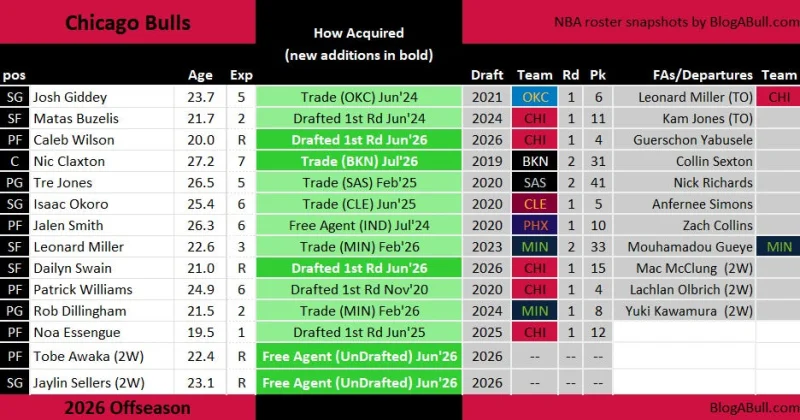
Bryson Graham defended the Bulls’ decision to sell pick #38 and pick #56 for cash by saying the roster was already being managed with the offseason in mind. His point was simple: a second-round pick is only worth taking if the team wants to use a spot on that player, and he did not want to spend one on someone he did not like when that same slot could be kept open for later in free agency or trades.
That explanation lands now because the Bulls roster is being judged in the middle of the draft cycle, when every move gets read as a clue about what comes next. The team can carry as many as 20 players in the offseason, but every team still has to get down to 15 roster spots plus 3 two-ways by the start of the regular season. Graham said that flexibility matters because the space is real only if it can be used later.
He also argued that the board had thinned out. Graham said the pool of players available in the second round had been reduced by NIL money keeping some players in school, which changed the math on what a late pick could return. In that frame, selling #56 for cash was not a pure talent decision so much as a decision about value, and Graham was blunt enough to say there was nothing justifiable about selling the pick outright.
Still, the trade around #38 leaves a nagging question. The Bulls moved that pick and cash, but the deal only brought back two future second round pick swaps and no additional picks, which is a modest return for a team saying it wants flexibility. That is where the roster logic gets harder to sell in public. Kam Jones, selected at #38 the year before by Indiana, was not part of the informal roster count and is likely to be cut while his salary remains only half-guaranteed at $1.1M. The cash in the trade likely covered that salary, which helps explain why the move made cap sense for the other side as much as it did for the Bulls.
That is why the real test is not whether Graham can explain the second-round moves, but whether he uses the open offseason space he says he is protecting. If the Bulls keep those spots clear and never turn them into help later this summer, the logic weakens fast. If they do use them in free agency or trades, then the draft-night choices start to look less like retreat and more like a roster built to stay movable.
