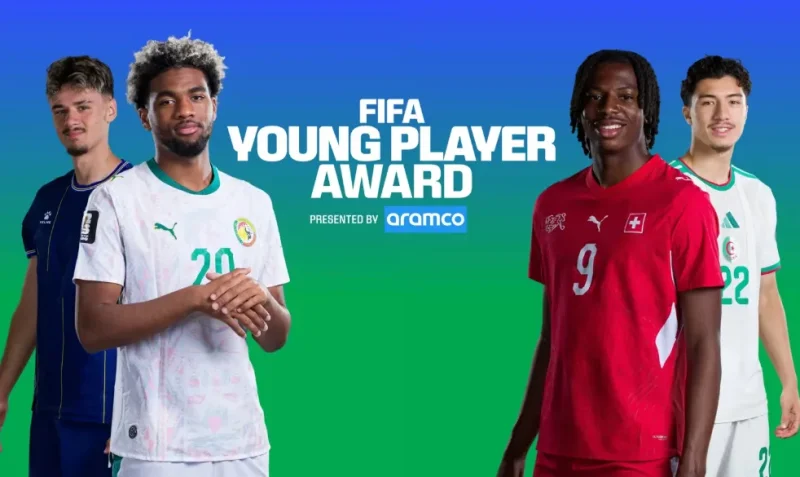
FIFA has highlighted 11 World Cup standouts born on or after January 1, 2005, and five of them are Africans, a fresh signal in the race for the FIFA World Cup 2026 Young Player Award. The list does not name a winner. It does show which youngsters have done enough on the field to force themselves into the conversation.
That is why the search around who is the youngest player in the World Cup is moving now. The Young Player Award goes to the outstanding player born on or after January 1, 2005, and Tuesday’s assessment updated the picture during the tournament, with African players making up nearly half of FIFA’s highlighted group. Among them are Yan Diomande, Ibrahim Maza, Ayyoub Bouaddi, Ibrahim Mbaye and Christ Inao Oulai.
Diomande has given FIFA plenty to work with. He registered an assist in Côte d’Ivoire’s 2-0 victory over Curaçao and became the only player this century to complete 10 dribbles and create 10 chances across his first three World Cup appearances. Maza also strengthened his case by featuring in all three group matches for Algeria and earning Superior Player of the Match in the victory over Jordan. Those are the kinds of performances that turn a shortlist into a real race.

Several non-African players have done the same. Ayyoub Bouaddi, 18, played in Morocco’s knockout-stage victory over Netherlands and had two shots in 79 minutes. Lamine Yamal, also 18, was instrumental in Spain’s 1-0 win over Uruguay. Johan Manzambi scored and assisted in Switzerland’s 2-1 win over Canada and has three tournament goals. Those outings matter because FIFA’s assessment is built on influence, not reputation.
The African case is still strong. Ibrahim Mbaye became the youngest African player to score at a FIFA World Cup at 18 years and 143 days, doing it against France. Kerim Alajbegovic became the eighth-youngest goalscorer in World Cup history during the group phase. Rayan became the youngest Brazilian since Pelé in 1958 to register a World Cup assist. The pattern is clear: the age bracket FIFA set is producing decisive moments across continents.
Luc De Fougerolles gives the race a different shape. He has 16 caps for Canada and 31 professional appearances, most of them with FCV Dender. Across his three matches, he recorded 18 defensive contributions and 12 clearances, then played 32 minutes in Canada’s 1-0 Round of 32 victory over South Africa. He may not have the flashiest attacking numbers, but his tournament has been built on minutes that held a result together.
What FIFA has done here is outline a field, not close it. The 11 players are age-qualified standouts, not a final winner’s circle, and the award is still open to anyone born on or after January 1, 2005 who keeps delivering. For now, the race is being shaped by African youngsters who have been the loudest names in the group, even as players from Spain, Switzerland, Brazil, Canada and Morocco keep pressing their cases.