


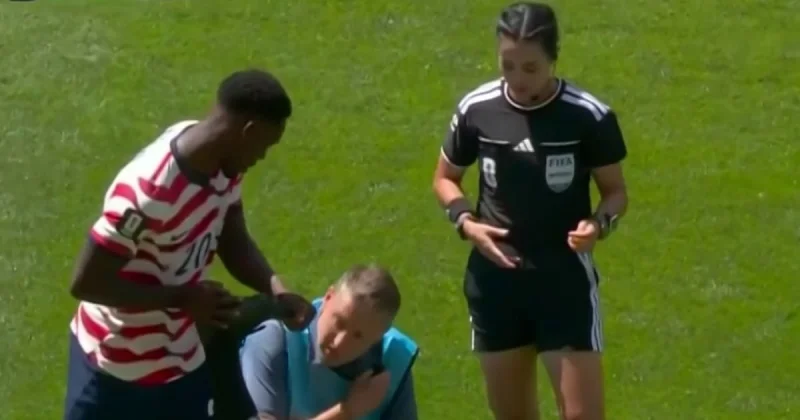
Katia Itzel García has been designated to referee Túnez vs. Países Bajos in Grupo F of the Mundial 2026, a decision that makes the 33-year-old the first woman from América Latina to serve as central referee in a men’s World Cup. The appointment also places her among only five women in history to hold that responsibility.
The assignment was enough to draw congratulations from Claudia Sheinbaum on Monday, and for good reason: it gives México a place in a short list that only began to exist at Qatar 2022, when Stéphanie Frappart, Salima Mukasanga and Yoshimi Yamashita became the first women to work as center referees in a men’s World Cup. Until then, women from Latin America had appeared in the tournament only as assistant referees, through Neuza Back and Karen Díaz.

García’s path to this moment is unusually direct. She began playing amateur football in 2004, moved into refereeing in 2015 and made her professional debut in 2016. Born in Ciudad de México, she studied at the Universidad Nacional Autónoma de México and later at the Facultad de Ciencias Políticas y Sociales, then stayed close to the game after her playing dream could not continue. In her own words, refereeing offered a place to build new dreams and goals and remain near football; she has also said the referee has the best seat in the stadium because it allows a view of every goal and the atmosphere from inside the pitch.
The historic weight of her appointment sits beside a smaller but telling fact: the breakthrough is still new. Women did not begin taking the center chair in men’s World Cups until 2022, and García now becomes the fifth to do it, after a route that had long kept Latin American women on the edge of the crew rather than in charge of the match. Tori Penso also debuted as a referee in the Mundial 2026 on Thursday, underscoring how limited, and how recent, the opening remains.
What happens next is simple and exact: García will take charge of Túnez vs. Países Bajos. FIFA has not said in public why she was chosen for that match, but the decision already stands as the clearest sign yet that the center referee role in a men’s World Cup is no longer closed to Latin American women.
