


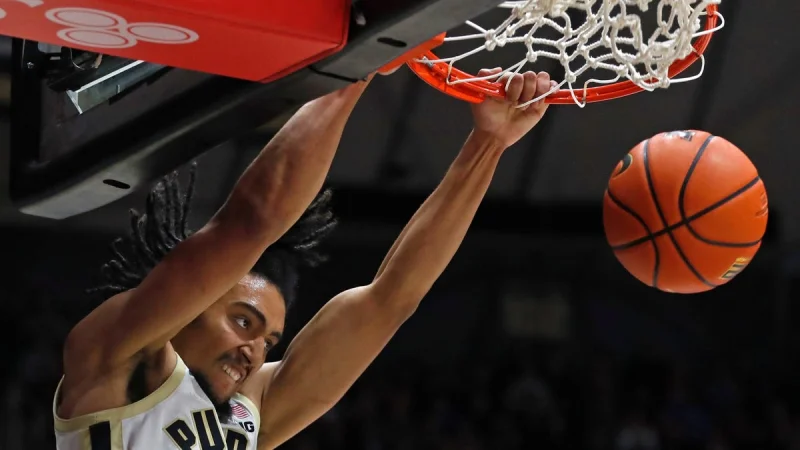
The Minnesota Timberwolves used the 59th overall pick on Trey Kaufman-Renn, a 23-year-old Purdue forward whose game points back to the paint more than the perimeter. It was one of the final moves of the draft, and it went to a player few expected to hear his name called at all.
Kaufman-Renn’s college line explains why he drew attention anyway. He averaged just over 14 points in 37 contests and did most of his work almost exclusively from the low block, where his touch was considered a clear strength. described him as having excellent touch but being unable to extend it meaningfully away from the basket, which is the kind of limitation that matters in a league built around space.
That is why the selection reads as a bet on one narrow skill rather than a finished NBA player. The Timberwolves took a 6-foot-9 scorer who was productive at Purdue, but the same profile also carries the warning signs: he is not a defender, not really a playmaker, and may not fit cleanly on an NBA roster. Late second-round picks are often made with development in mind, and this one fits that mold.
There is still a practical question behind the pick. Kaufman-Renn may end up as a piece for the Iowa Wolves, which would give the Timberwolves time to see whether his touch around the basket can outweigh the parts of his game that remain incomplete. The 59th overall pick has yet to produce a real NBA talent, so this is less a promise than a test of whether one old-school scorer can find a place in a modern rotation.
The timing also adds to the oddness of the choice. On Sunday, the Timberwolves released their new jersey design to the public at Target Center, a separate reveal that underscored how much of the franchise’s public face is being updated even as the draft end of the roster remains open to projects. Kaufman-Renn now sits at the center of that lesser-known part of the plan: a player with a proven college résumé, a narrow offensive package and no obvious answer yet on where he fits next.
