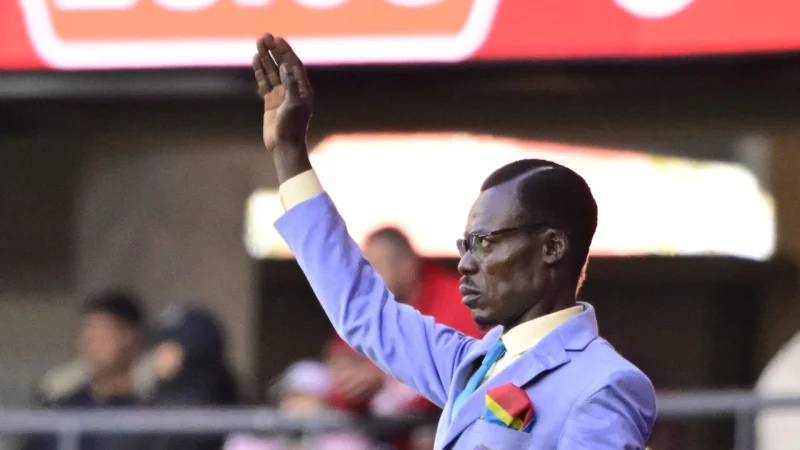
Michel Kuka Mboladinga, the Congolese fan known as Lumumba Vea, is in Mexico for the World Cup match against Colombia after players pushed for him to join the Democratic Republic of the Congo delegation. He will do what has made him a fixture at team games: stand motionless, dressed in the colors of the Congo flag, and copy the statue of Patrice Lumumba in Kinshasa.
His presence matters because he has become more than a superfan. Mboladinga said he stands still because he believes it gives the team emotional stamina, and he has put that belief into ritual at matches for years. At the Congo vs. Botswana match at the Africa Cup of Nations in December 2025, he wore a yellow striped blazer, a blue-and-white gingham shirt, a blue satin tie and a pocket square in sky blue, sunny yellow and bright red. At a later match against Algeria in January 2026, he wore a blue blazer, a butter yellow shirt and cherry red trousers.
Patrice Lumumba, the late revolutionary and inaugural Congolese Prime Minister, remains a charged symbol in the country. He was a key figure in the Congo's fight for independence from Belgium, which the country achieved in 1960, before Joseph-Désiré Mobutu removed him from office several months later. Lumumba was killed in early 1961 at the hands of the Belgian government, and Mboladinga has turned that history into a public act of loyalty that fans and players have come to recognize instantly.
The friction around that loyalty was travel, not sentiment. All travelers from the Democratic Republic of the Congo were required to quarantine for 21 days before entering the United States because of an ebola outbreak, but the players lobbied Félix Tshisekedi to make Mboladinga part of their official delegation. That allowed him to isolate in Belgium with the team and official members of the Fédération Congolaise de Football Association, even though his quarantine there overlapped with the team's first match against Portugal in Houston.
By the time the World Cup match against Colombia arrived, Mboladinga was already in Mexico, where his stillness was meant to carry the same message it always has: support that does not move, but does not fade. Véron Mosengo-Omba captured the appeal in a few words, saying, “They love him a lot,” and calling Mboladinga a national symbol of resilience and pride.