


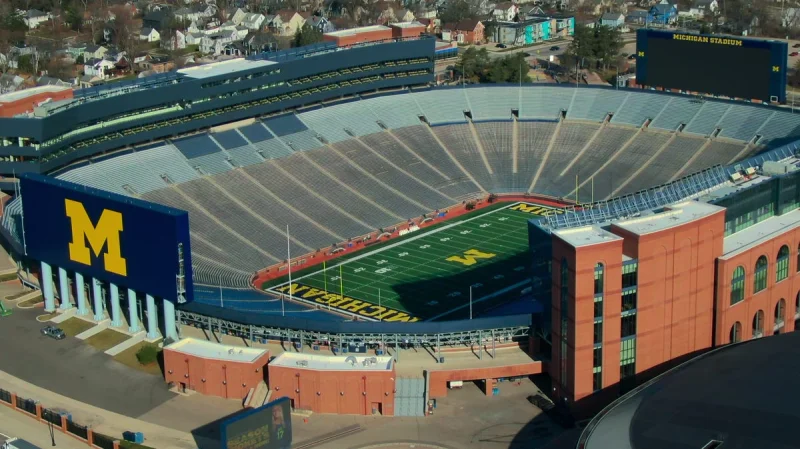
Warde Manuel said Michigan is weighing jersey patches and new in-stadium advertising to generate more money for NIL support across all 29 varsity sports, a step that could mark a careful break from the department’s long habit of keeping Michigan Stadium largely free of ads.
He laid out the move in a Thursday letter to fans, writing at a moment when the NCAA has already opened the door. Commercial uniform patches can begin Aug. 1, and about a dozen schools have already revealed patch deals. Michigan has not gone that far yet, but Manuel’s message makes clear the department is now studying where it can expand without changing the feel of the program too much.
The possible revenue streams are broader than a jersey patch. Manuel said the department is exploring on-field and on-court logos, digital scoreboard advertising and in-game sponsorships, all with one stated goal: keeping NIL support strong across the department. That matters because Michigan’s athletic operation is trying to fund a wide range of teams, not just the biggest ones, and the new money would be meant to help all 29 sports.

Michigan has historically tried to keep the Big House clean. Manuel wrote that the university has intentionally protected Michigan Stadium from the kind of commercialization seen elsewhere, limiting visible ads to the Big Ten Conference logo, the Allstate field goal nets, and existing partnerships with Nike, Jordan and Gatorade. Last year, the Allstate Good Hands field goal nets debuted there, and Allstate now donates $1,500 for every extra point and $500 for every field goal to the Michigan athletic scholarship fund.
That caution is what makes the new discussion more than a simple business update. In December, Manuel said it was imperative to find ways to drive revenue beyond donors, season-ticket holders and the fan base, and he said then that if Michigan adopted the kinds of ads common elsewhere, the number could reach tens of millions of dollars. He also said the school has long looked at options such as permanent signage, but had not needed to lean on advertising at Michigan Stadium because it had kept the venue as clean as possible.
Now the department is trying to square those instincts with the economics of modern college sports. Manuel said any advertising would be introduced strategically, tastefully and in a way that fits the values of the University of Michigan, and he added that Michigan Sports Properties and Learfield are already in discussions with potential sponsors for the new Leaders and Best Champion Partner Program. The unanswered question is how far the school is willing to go after spending years treating the stadium itself as a limit line. For now, Manuel’s message is that the search for revenue is no longer hypothetical, even if the final shape of it still is.
