


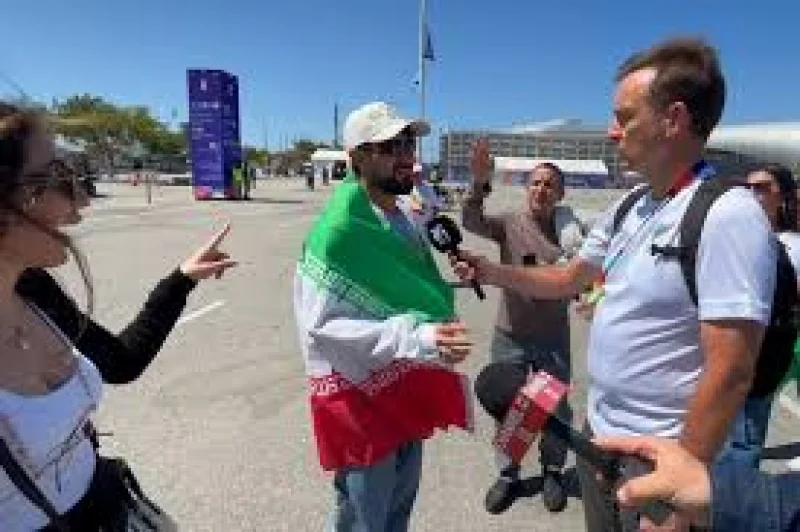
A Los Angeles judge on Monday upheld FIFA’s ban on the pre-revolutionary Iran flag, leaving the restriction in place just hours before Iran’s first World Cup game. The ruling came after an emergency hearing that was rushed onto the calendar in Los Angeles County Superior Court.
The challenge was filed on Thursday by the Institute for Voice of Liberty and Sam Kermanian, who wanted to bring the flag into SoFi Stadium in Inglewood, California for the match against New Zealand. The flag is similar to Iran’s official flag, but it carries a lion and sun motif in the center and is tied to the country’s pre-1979 Shah-led regime.
That timing is what gave the case its urgency. Kermanian was seeking a court order before the opening whistle, and the hearing was moved up so a judge could decide whether ticket holders could carry the banner into the stadium before the teams took the field.
Judge Curtis A. Kin said the ban should stand. He said free speech matters, but it is not unlimited on private property, and he said a stadium that requires a ticket is not the same as a park or a street. He also said changing a long-standing stadium protocol for a massive event in a matter of hours would be a tremendous burden, and it was hard to see how FIFA could change the rule at one stadium and not the rest.
Lawyer Shahrokh Mokhtarzadeh argued that a business should not be allowed to force a customer to give up speech rights as a condition of entry. He said he was speaking for 5,000 members of the Institute for Voice of Liberty and argued that many in California’s large Iranian community would not want to walk in carrying the Islamic Republic flag. He also said the World Cup should be treated as a joint venture between FIFA and governments, which would make the stadium more like a public forum than a private venue.
FIFA pushed back by saying the plaintiffs were well aware of the match for many, many months and that emergency relief was not appropriate. The governing body has long pointed to its stadium regulations on what can and cannot be brought inside venues, and it had previously provided a list of banned items from that code of conduct. The dispute turned not on whether the flag carries political meaning — it plainly does — but on who gets to control that meaning once fans reach the turnstiles.
For Kermanian, the decision meant the flag he wanted to carry into the stadium stayed outside. For FIFA, the ruling preserved a protocol it said applies across venues, not just for one game in Inglewood. What remains unanswered is whether that rule will be tested again later in the tournament, or whether Monday’s ruling settles the matter for the rest of the World Cup.
