


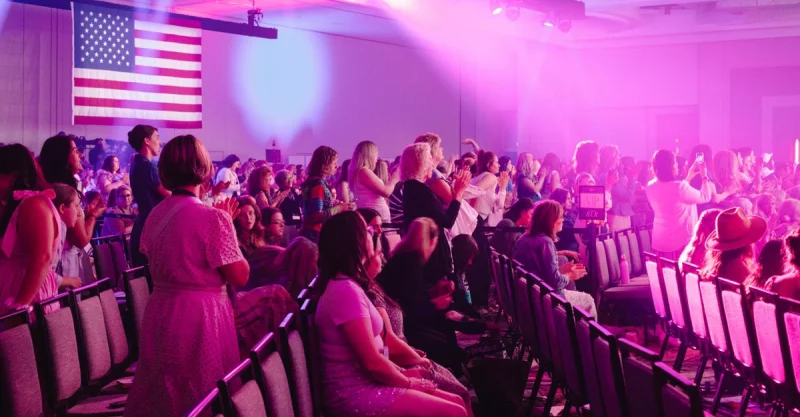
Turning Point USA’s annual Women’s Leadership Summit in San Antonio opened this year with a noticeably softer edge than the event has carried in the past. In a ballroom at the San Antonio Marriott Rivercenter packed with 3,000 women, speakers talked less like political operatives and more like hosts trying to make room for different lives, different choices and different timelines.
That shift matters because the search for Erika Kirk is really a search for what the conservative women’s movement looks like after Charlie Kirk’s death last year. He founded Turning Point and had spent years telling women to marry young, have children and reject feminism, including advice to skip college or treat it as an “MRS degree.” At last year’s summit, he told the crowd that women who were not married by age 30 were less likely to find a husband and less likely to have children.
This year’s gathering did not sound like that. Before each speaker took the podium, tall columns of magenta smoke blasted from both ends of the stage. Alex Clark told the crowd, “Never getting married is not a failure,” a line that would have been hard to imagine at a prior Turning Point women’s event. Alyssa Cromwell went further, saying the summit was “all about support and recognizing that everybody’s journey is different.” She also described it as “coming together, supporting women, and being a safe space to embrace ourselves.”
The contrast was not subtle. When Erika tried to soften Charlie Kirk’s message for single women in the audience, he brushed it off as “happy talk.” Yet the summit now presented a more inclusive tone, one that left room for women who do not fit the older script. No speaker alluded to the upcoming midterm elections, either, which was another sign the event was not being staged as a campaign tool the way it had been in 2024, when the same hotel hosted a women’s summit that doubled as a get-out-the-vote operation and featured Alina Habba and Lara Trump.
That makes this year’s summit look less like a one-night pep rally and more like a test of direction for Turning Point itself. The organization still stands behind the same basic conservative view of womanhood, but the language in San Antonio suggested a broadening of tone, if not yet of mission. Whether that softer approach is a temporary adjustment or the start of a deeper shift is the question Erika now leaves behind at the podium.
