


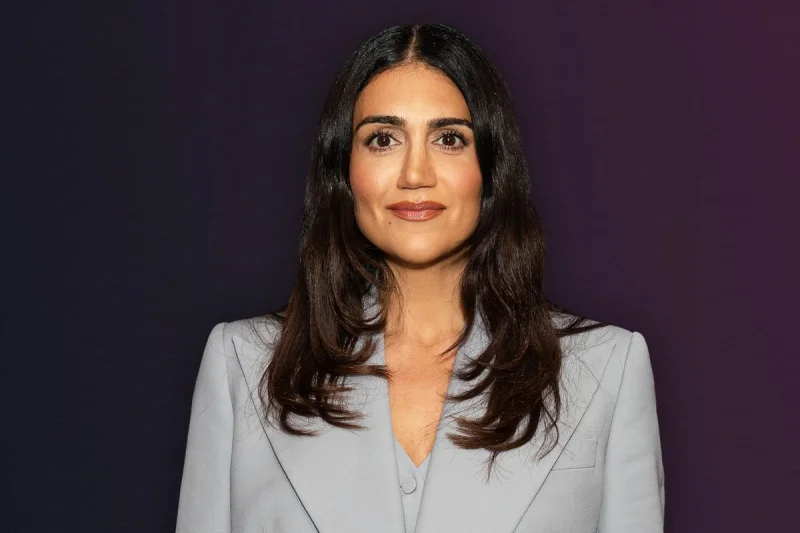
Leila Farzad says she belongs to Iran, but she has not been able to go back since her teens. Now the London-born actor is putting that contradiction onstage, starring in Under the Shadow at the Almeida this month in a role shaped by the country she still feels tied to and cannot easily enter.
That makes her latest part more than a career move. Farzad plays a mother and aspiring doctor living through the Iran-Iraq war in Tehran, in a stage version of the Bafta-winning 2016 horror film Under the Shadow. For her, the production lands at a moment when the connection is unusually sharp: she is speaking publicly about a homeland that formed her childhood and then became increasingly out of reach.
Farzad was born and raised in London, but she spent every summer in Iran when she was small, at her grandma's house. She said it was “so familiar yet foreign,” and that it felt like “that strange thing of belonging in two places.” Born in 1981, just over a year into the conflict in her parents' home country, she is now returning to a story rooted in the years that shaped so much of modern Iranian life.
The play is set almost entirely in one apartment in Tehran, a tight frame for a wider history. Farzad said most Iranians speak in terms of before the revolution or after the revolution, and called 1979 “the big punctuation mark in their lives.” After that break, she said, Iran became an Islamic Republic, strict religious laws were put in place, women's rights were reversed and alliances with the US broke down. Her own memory sits inside that shift, even if she experienced it from abroad.
What gives her account its edge is the reason she stopped going. Farzad said her career choice was not one that would allow her to travel across to Iran easily, and that it became more complicated and more dangerous. She did not spell out every practical barrier, but the result is plain enough: she says it is strange to belong to a country she cannot travel to herself. That friction sits underneath the performance, where the personal and political are never far apart.
Farzad worked with Nadia Latif and Carmen Nasr on the production, bringing together a Sudanese director and a Lebanese writer on a story set in Tehran. The production opens this month at the Almeida, and it arrives with a built-in question that the stage cannot soften: what does belonging mean when the place that formed you is still present in memory, but closed to you in practice?
