


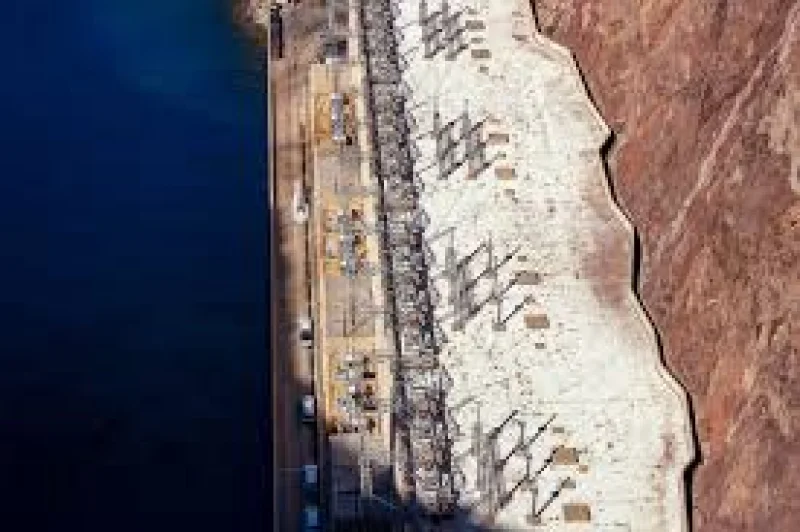
Hoover Dam is moving toward a line that water managers have been watching for more than a year and a half. When Lake Mead falls below elevation 1,035 feet, the dam’s hydropower output will be cut by 70 percent.
That threshold is now close enough to matter. Lake Mead was at 1,050 feet earlier this month and falling at roughly one foot every five days, putting the trip wire within months rather than years. Tom Buschatzke said in mid-May that the reservoir would reach 1,035 feet and added that there was no doubt it would happen.
The number matters because Hoover Dam remains one of the Colorado River basin’s most flexible sources of electricity, and the drop would hit power customers and the broader grid at the same time. Twelve of the dam’s 17 turbines are not designed for low-water operation below 1,035 feet, which is why the loss is so steep when the reservoir dips past that mark.
The federal government is trying to blunt the blow, but not fast enough to avoid it. On May 21, the Bureau of Reclamation said it will spend $52 million on three new wide-head turbines that can generate power down to 950 feet. Once those units are installed and working alongside the five wide-head turbines already in place, the cut below 1,035 feet would fall to 58 percent instead of 70 percent.
For now, though, the old equipment still sets the limit. The new turbines have not yet been installed, and the dam is likely to cross the 1,035-foot line before they are ready, leaving Hoover Dam exposed to a major capacity reduction in the meantime.
The risk at Hoover Dam is tied to strain upstream at Glen Canyon Dam, which forms Lake Powell. In April, Reclamation cut Lake Powell releases by 20 percent to protect fragile water-delivery infrastructure and keep hydropower running there. Without holding back water and releasing more from upstream reservoirs, Lake Powell would have dropped below its own hydropower trip wire by the end of the summer.
That is the uneasy math now facing the Colorado River system: reservoirs with low-water trip wires stacked one after another, each one forcing a choice that pushes stress downstream. Lake Mead could slip below 1,035 feet later this summer, possibly in late August or not until next spring, but the dam’s power loss is no longer a distant possibility. It is the next phase of a problem already in motion.
