


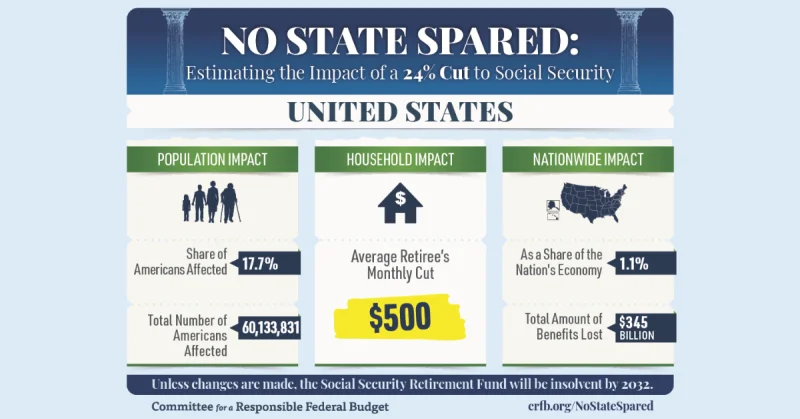
Social Security’s retirement trust fund is now projected to run out in 2032, and when it does, benefits would be cut by an estimated 24% unless Congress acts first. The change would hit 63 million Americans, from retirees to spouses, survivors and dependents, turning a long-warned problem into a deadline with a year attached.
That deadline matters now because the program is already spending more than it takes in, a gap that has persisted for 16 years. Lawmakers have known for 42 years that the retirement system would be insolvent without changes, but the latest projection makes the loss concrete: an immediate reduction that would average about $500 a month nationwide and would range from $459 to $556 across the states and the District of Columbia.
The scale is broad enough to touch every corner of the country. No state would be spared, and in 29 states the monthly cut would top $500. Retirees in Connecticut, Delaware, Maryland, New Hampshire and New Jersey would face the largest reductions, while between 10% and 23% of each state’s population would be affected if the cut took effect today.
The numbers also show how quickly the shortfall would hit household budgets. A 24% reduction in benefits would amount to about $345 billion nationally in the first year, equal to 1.1% of GDP. State-by-state losses would run from 0.2% to 1.9% of GDP, with West Virginia, Mississippi and Vermont facing the steepest hits, followed by South Carolina and Maine.
That is where the friction sits: policymakers are being told to move quickly, yet the trust fund is still projected to last until 2032. The report is built on Social Security Trustees projections and state-level estimates, but it does not identify a fix, only the consequence of delay. Without changes before the trust fund is depleted, the law will force benefits down to the revenue coming in, and the cut will fall on the 54 million retired workers and 9 million survivors and dependents who rely on the program.
The question now is not whether the shortfall is coming. It is whether Congress can agree on a repair before the calendar reaches 2032 and the benefit cut becomes automatic.
