


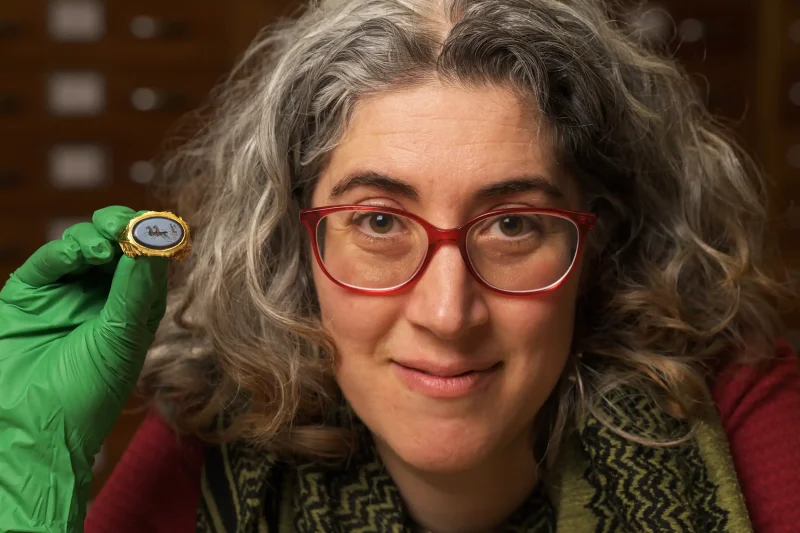
A rare Roman gold ring found in a Somerset field near Ilminster has been bought by the South West Heritage Trust with a hoard of 297 Roman coins for £78,000, ensuring the treasure stays in Somerset.
The trust announced the acquisition on Tuesday, saying the 48-gram ring, which dates to around AD297, was an unparalleled discovery for Britain. The gemstone set in it is finely engraved with Victoria, the Roman goddess of victory, driving a two-horse chariot, a design that gives the ring both the scale and the finish of a ceremonial object rather than a simple ornament.
The find matters now because it closes a chapter that began years ago at the same site. Kevin Minto first uncovered Roman coins there in 2017 and then found the ring in 2018, building what became one of the most unusual Roman discoveries in the region. The site has also yielded a lead-lined coffin on another occasion, underlining how much of south Somerset’s past is still coming to light one field at a time.
Amal Khreisheh said the Ilminster ring was likely worn on important occasions or may have had a ceremonial function. She also said the find helps explain how Roman inhabitants in south Somerset navigated a period of unrest from 286 to 296, and that the ring was probably buried shortly after, in 297, with coins, lead and pottery objects. The trust’s view is that the hoard does not just add to the record; it sharpens it.
There was, however, no neat ending when the ring surfaced. It was found on the day of a military veterans’ detecting rally, and there was a dispute about who was entitled to the proceeds, a reminder that archaeological discoveries can bring legal and personal complications as well as excitement. In the end, the landowner received half the money and Minto split his share with the metal detecting friend he worked with on the find.
Minto said the discovery was overwhelming, describing it as being hit by an express train and adding that he was dumbfounded when he realised the object in his hand was a ring. He has since paid off his mortgage and cut his lorry driving to four days a week. For him, the outcome is straightforward enough: “I’m chuffed it’s staying,” he said. “That seems right to me, somehow.”
What remains open is whether the ring was made in Britain or elsewhere. Further analysis may settle that, but the larger point is already fixed: one of the most striking Roman finds recovered in Somerset is no longer a private story or a contested prize. It is staying in the county, where it can be studied and seen as part of the record of Roman Somerset.
