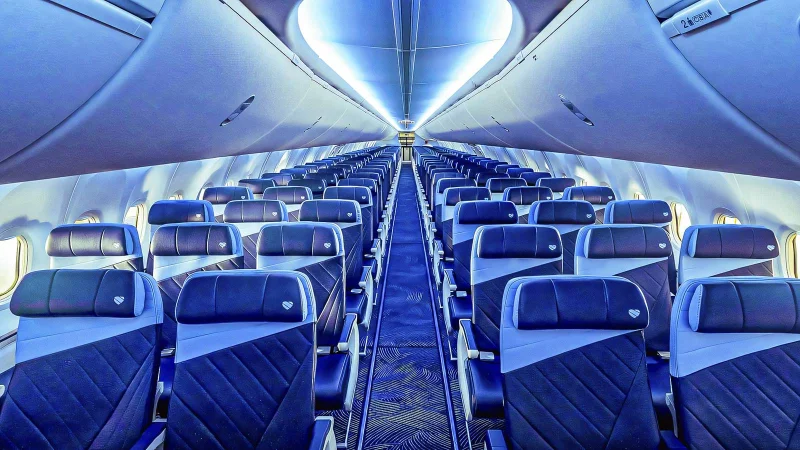
Southwest Airlines has abandoned open seating, and the change is already reshaping how passengers move through its cabins. On January 27, 2026, the carrier officially switched to assigned seats and eight boarding groups, ending a system that had defined the airline for more than five decades.
Early reports from the first days of the new setup describe a boarding process that looks and feels different in the worst possible way. Passengers are no longer spreading naturally through the cabin after choosing any open seat. Instead, they are stopping in the aisle, backing up, and hunting for overhead locker space near the row they have been assigned, a pattern that slows everyone behind them.
That matters because Southwest built its business around speed. For 53 years, the airline designed its operation around rapid turnarounds, and the open seating model helped make that possible by minimizing ground time and maximizing aircraft utilization. The carrier flies more than 800 Boeing 737 aircraft, and its network depends on repeated short-haul segments through the day, with individual planes often completing multiple flights daily.

On a narrowbody aircraft like the Boeing 737, only one passenger can move through the aisle at a time. That makes boarding friction expensive. Even five extra minutes on average can compound fast across a fleet of more than 800 aircraft, turning a small delay into a large operational hit over the course of a day. The airline's short-haul system was built to squeeze every minute out of each jet; the new boarding routine puts pressure on the very thing that made the model work.
The reaction so far has also revealed a mismatch between what passengers expected from the change and what the airline was really changing. Much of the early attention focused on complaints and nostalgia, but the bigger story is operational. Open seating survived for decades not just because some travelers liked it, but because it fit Southwest's network better than almost any alternative. The shift to assigned seats may solve one customer complaint, but it risks creating a slower boarding process on the carrier most dependent on fast turns.
That trade-off will now be measured in real time across the system. If boarding keeps dragging, the impact will not stay in the gate area. It will move through the schedule, flight by flight, on a fleet built for speed.