


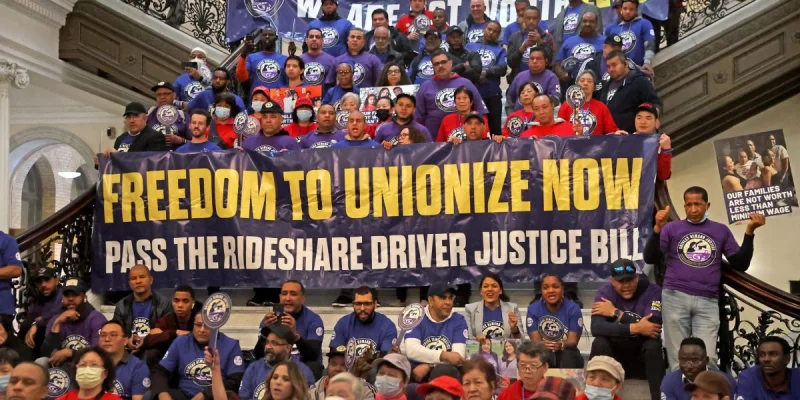
Drivers for ride-hailing apps such as Uber and Lyft in Massachusetts became the first in the nation Tuesday to certify a union, a milestone that could reshape the app-based work force in the state and beyond. The new labor organization was made possible by a 2024 ballot measure that let drivers unionize and bargain collectively while remaining independent contractors.
Organizers say the union could eventually represent nearly 70,000 drivers statewide, a scale labor leaders are comparing with the largest private-sector organizing win since Ford autoworkers unionized in 1941. For Jean Fredo, who has driven for Uber for more than seven years, the vote was a break from a system he says leaves workers exposed to sudden punishment. Drivers can lose access to the apps with little warning or chance to appeal, he said, and that insecurity shaped his decision to get involved. He said he immediately joined the effort after hearing about it and later helped sign up hundreds of other drivers at airports and gathering spots around the Boston area.
“With the union, it will not feel like we’re working for nothing,” Fredo said. “Now the money will not only stay in the billionaire’s pockets. The money will actually come to the workers who work very hard.”
Victoria Acosta, who drives for both Uber and Lyft, said the campaign only succeeded because drivers kept showing up, even when the odds looked long. She spent months knocking on doors, testifying at hearings and speaking with hundreds of other drivers as organizers built support for the union effort. “Without the support of the drivers, we wouldn’t be here,” she said. “If we did it, they can do it, too.”
The effort grew out of years of frustration over rising vehicle costs, fluctuating pay and app algorithms that many drivers say are impossible to see inside or challenge. Fredo said the pressure has been constant. “I live with stress — always scared to lose my app,” he said. “This is not a way to live.”
The Massachusetts vote also arrives as app-based drivers face another shift: the rapid advance of self-driving technology. Uber and Lyft have argued that drivers value the flexibility of app-based work and have opposed efforts that could reclassify workers or alter the industry. But in Massachusetts, voters created a framework that let drivers organize without changing their contractor status, and Tuesday’s certification showed that the model can move from theory to practice.
The win is already being discussed as a possible blueprint for campaigns in California and Illinois, where labor groups are watching closely for signs that the Massachusetts approach can travel. For Fredo, the goal is simpler and more personal. “This is my family,” he said. “I’m fighting for a better life for them — just like everyone else is fighting for their families.” He said his dream is to save and send his children to college, “and I believe we will get there.”
