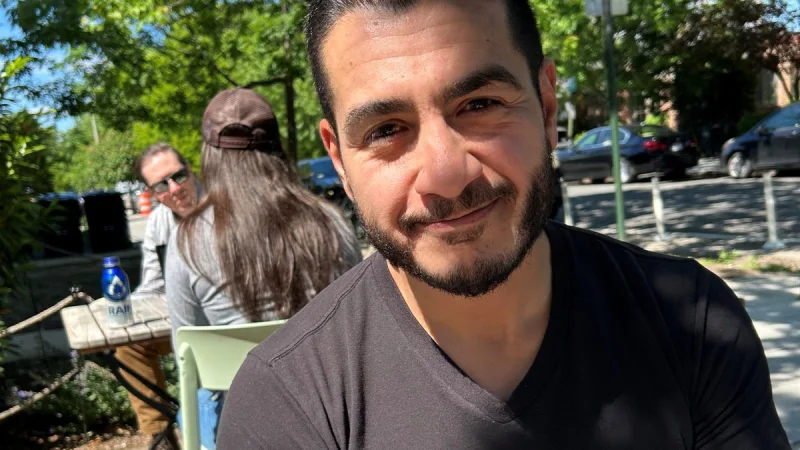
Abdul El-Sayed says Michigan voters will look past his name, his religion and the race he lost seven years ago, and decide he is the Democrat best built to take on Republicans for an open U.S. Senate seat. In an interview on May 15, the former Wayne County and Detroit health director said he believes he can beat Mike Rogers by 7 percentage points if he wins the Aug. 4 primary.
El-Sayed, 41, is making that case while holding a slight polling lead over U.S. Rep. Haley Stevens and state Sen. Mallory McMorrow, though a plurality of likely primary voters still appears undecided. He is the most progressive candidate in the field, and his allies include Bernie Sanders and Rashida Tlaib. The race is for the seat now open in a state that has become one of the country’s most closely watched battlegrounds, and the general election may ultimately hinge on whether Democrats can unify around a candidate who can keep pace with a Republican Party favorite.
He has been here before. In 2018, El-Sayed lost the Democratic nomination for governor to Gretchen Whitmer, a defeat that left him with a better-known name in Michigan politics but also a clear warning about the limits of his appeal. This time, he is betting that the voters who said no then will see him differently now: as a public health official with a record he says is strong enough to answer doubts about his background and his odds.
“No. 1, most people say this (I can't win) because of my name,” El-Sayed said. “I've been Abdul in Michigan my whole life and I know that Michiganders are big-hearted. They care less about what your name is, they care that you care to know their name. They care less about how you pray, they want to know what you pray for.”
El-Sayed is Muslim and the child of Egyptian immigrants. He studied to be a doctor before moving into public health, and he is leaning hard on that story as he argues that his record is more relevant than the assumptions voters may bring to his candidacy. He said he wants to “get money out of politics, put money in your pocket, pass Medicare for All.”
He also cast the race in blunt, almost prosecutorial terms, aiming directly at Rogers. “This guy voted 60 times to raise prescription drug prices,” El-Sayed said. “He helped to architect the legislation that kicked off the opioid epidemic.”

Then he turned to his own resume. “And I'm the guy who rebuilt Detroit's Health Department, eliminated $700 million in medical debt, and put Narcan in 100 different locations,” he said.
That contrast is central to his campaign, especially against a Republican who enters the race as the prohibitive favorite for his party’s nomination. Rogers lost a close race two years ago to Democratic former Rep. Elissa Slotkin, and Democrats are hoping that history can repeat itself in a different form if they settle on a nominee who can hold the line in a state that has repeatedly gone to the wire.
El-Sayed said he thinks he can win back voters Democrats have lost, particularly Arab and Muslim voters and young men. “Think about who we can win back,” he said. “We lost voters. Arab and Muslim voters, we lost young men, and I feel well-placed to have a conversation with those voters about what it looks like to actually be consistent with our values, and we're going to need that if we're going to be able to pull folks back.”
He said he sees a broader opportunity in energizing younger voters. “Imagine what happens when you inspire young people to actually come out for a politics they believe in, and think about how you can change the electorate,” El-Sayed said.
Still, the general election case for any Democrat remains unsettled. Some polling suggests El-Sayed could struggle against Rogers, while other surveys show him gaining ground. That uncertainty is part of the tension inside the primary: El-Sayed is asking Democrats to trust that a candidate many view as too far left can actually assemble a winning coalition in November.
He framed that bet in national terms, tying Rogers to Donald Trump and arguing that the former president is dragging down anyone associated with him. “And then the last thing I'll just tell you is that this man has tied himself to Donald Trump,” El-Sayed said. “Donald Trump is about as popular as rotten eggs right now, and he's getting less popular every single day. He's a beta character at a comedy based in a country club that nobody likes to watch. He's like the guy who laughs extra hard at the dumb joke that the alpha guy told. And nobody wants that guy as their next U.S. senator.”
For now, El-Sayed’s challenge is simpler and harder at the same time: turn a slight polling edge into a nomination before Aug. 4, then prove that a candidate who has already lost one statewide race can finally turn Michigan’s political turbulence to his advantage.