


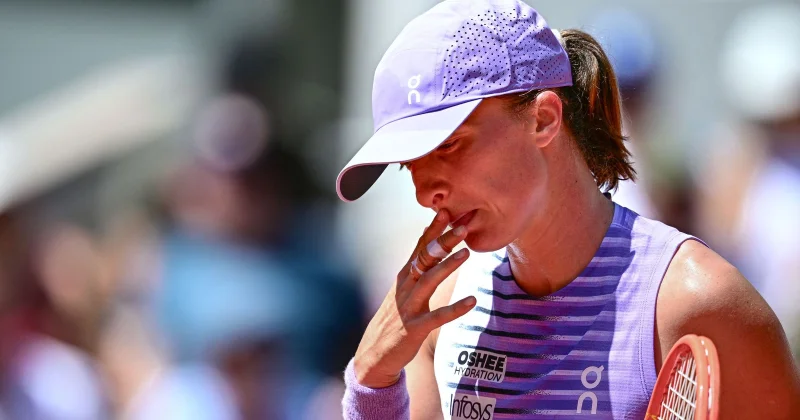
Second-round singles action begins Wednesday in Paris, and the French Open 2026 draw quickly turns into a showcase for the No. 2 and No. 3 seeds in both the men’s and women’s fields. Iga Swiatek opens the day at 12:00pm on Court Philippe-Chatrier against Sara Bejlek, Elena Rybakina follows on Court Suzanne-Lenglen against Yuliia Starodubtseva, and Novak Djokovic is set to play Valentin Royer third on Philippe-Chatrier.
The Day 4 schedule also sends Tomas Machac against Alexander Zverev not before 8:15 on Philippe-Chatrier, while Joao Fonseca meets Dino Prizmic third on Court 14 and James Duckworth faces Rafael Jodar third on Court 7. It is the kind of order that makes a Grand Slam draw feel immediate: the biggest names are on the main stages, but the players trying to break through have already earned their place in the second round.
Swiatek’s name still carries the most weight on the women’s side. She dropped just three games in her opening round and has reached the second week in all seven of her prior Roland Garros appearances, a record that explains why every opponent here has to treat the early rounds like a final. Bejlek, though, is not arriving without confidence. She beat Sloane Stephens on Sunday, reached a surprise final earlier this year in Abu Dhabi as a qualifier, and has already shown enough to worry top players, even if injuries to her back and abdominal area have limited her over the last few months.
Rybakina enters with a similar opening-round statement after dropping just four games on Sunday, but the stakes around her are different. She is trying to advance beyond the Roland Garros quarterfinals for the first time, and Starodubtseva arrives with her own recent proof of form after also losing just four games in the last round. Starodubtseva is trying to reach the third round for a second straight year, which gives the match a simple shape: one player trying to keep a breakthrough run alive, the other trying to get deeper at a tournament that has resisted her.
The men’s draw carries a different kind of friction. Fonseca won a rowdy contest against France’s Luka Pavlovic in straight sets on Sunday, and now the 20-year-old faces Prizmic, who has put together 26 matches this year at all levels, including 19 matches on clay, a Challenger title on the surface and upset wins over Ben Shelton in Madrid and Djokovic in Rome. Prizmic grew up idolizing Djokovic, which is part of what makes this section of the draw feel so compressed: the next generation is not waiting politely for space.
Duckworth’s meeting with Jodar has its own backstory. Jodar won his opening round with the loss of only five games, while Duckworth benefited from a mid-match retirement by Gabriel Diallo and came in with a 1-8 lifetime record at Roland Garros. That kind of number does not decide a match on its own, but it does explain why one side walks onto the court looking for an opening and the other walks on trying to prove a pattern wrong.
Djokovic’s match against Royer is the one that will draw the loudest attention on Philippe-Chatrier. He came back from a set down on Sunday night against Giovanni Mpetshi Perricard for his first match win in two-and-a-half months, in just his third event since reaching the Australian Open final in January. Royer is 0-2 in the second round of majors, so the draw gives him a familiar test and an unforgiving stage. Djokovic turns 39 this week, but the schedule does not soften because of age, and the crowd in Paris will know exactly what kind of reference point they are watching.
Machac and Zverev close the main-court picture, with both players having won their first-round matches in straight sets. Zverev also beat Machac 6-3, 7-5 at the Paris Olympics two years ago, a result that matters because the margin was tight enough to suggest the matchup is closer than the head-to-head alone might imply. That is the nature of this day in Paris: the draw has moved into the round where ranking, memory and momentum start colliding, and there are no easy courts left.
