


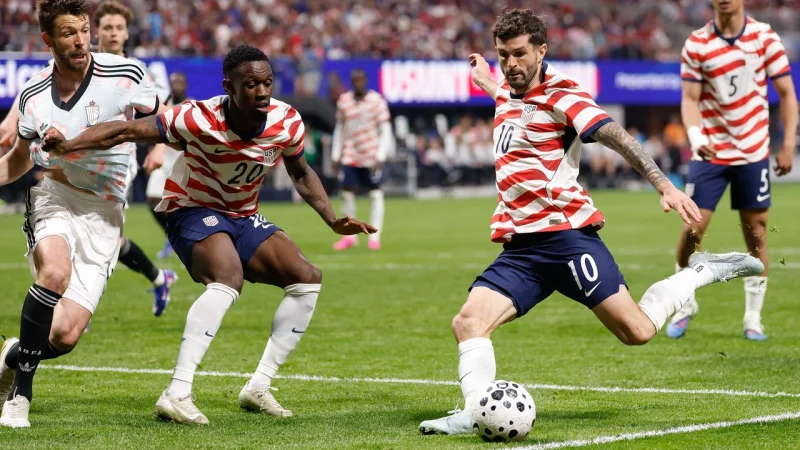
The U.S. World Cup roster was expected to be a relatively uneventful and inconsequential release on Friday morning. It was not. Around 1 p.m. Friday, U.S. Soccer emails reached players, and Tanner Tessmann was told by email that he was not on the roster for the 2026 World Cup.
The omission matters because Tessmann had been in the mix for a starting role, had featured in each of the last six USMNT games and had started the opening games of the October, November and March windows in a double-pivot. Before the roster call, he had been viewed as a potential World Cup starter, even after a muscle injury earlier in the month.
A source briefed on the injury told The Athletic there was no concern about Tessmann’s World Cup availability, which made the decision feel less like a health call and more like a competitive one. That is a sharp turn for a player whose form and playing time had dipped at Lyon before the injury, but who still looked like part of the midfield core when the team was being sorted out.
The roster picture changed again when Johnny Cardoso suffered an ankle injury that required surgery and ruled him out of the tournament. Cardoso’s absence removed another possible midfield option, even as the USMNT midfield had appeared deep before the roster was finalized. Tyler Adams is now the roster’s only defensive-minded midfielder playing his club soccer outside MLS, and the assumption had been that he would slide into his standard position alongside Tessmann.
Instead, Mauricio Pochettino has a narrower set of choices. Christian Pulisic and Weston McKennie were expected to play ahead of Adams and Tessmann, but Pochettino could still insert Sebastian Berhalter or Cristian Roldan next to Adams, or move McKennie into a deeper role. Between Roldan and Berhalter, Roldan would be the better option, while McKennie’s success at Juventus this season makes him the best choice in a vacuum.
That does not make the alternatives simple. Roldan was excellent at the Club World Cup last summer against Botafogo, Atlético Madrid and Paris Saint-Germain, and Berhalter was superb for the Vancouver Whitecaps in big moments. Both players’ performances against Lionel Messi and Inter Miami in knockout tournaments helped convince Pochettino to call them up in 2025. But they also play in a league that moves at a snail’s pace compared with Europe’s Big Five, and Berhalter looked out of his depth when paired with Adams against South Korea last September. He is not really a holding midfielder.
The contrast with Tessmann is stark. In October, November and March, he kept getting the first look in midfield, sometimes with Aidan Morris, sometimes with Cristian Roldan and once with Cardoso, while Adams missed those games because of the birth of his son and then injuries. Now Adams is healthy enough to anchor the group, Cardoso is out, and Tessmann is not in it. That leaves Pochettino with a midfield puzzle that looks much less settled than it did before Friday’s announcement, a point made even sharper by the uncertainty elsewhere in the squad, including the issue around Chris Richards’ injury that has already put parts of the USMNT World Cup plan in doubt.
For a roster release that was supposed to pass quietly, it produced the kind of decision that can shape a tournament before a ball is kicked. Tessmann’s absence is not just a surprise; it is a sign that the final midfield hierarchy was never as fixed as it seemed.
