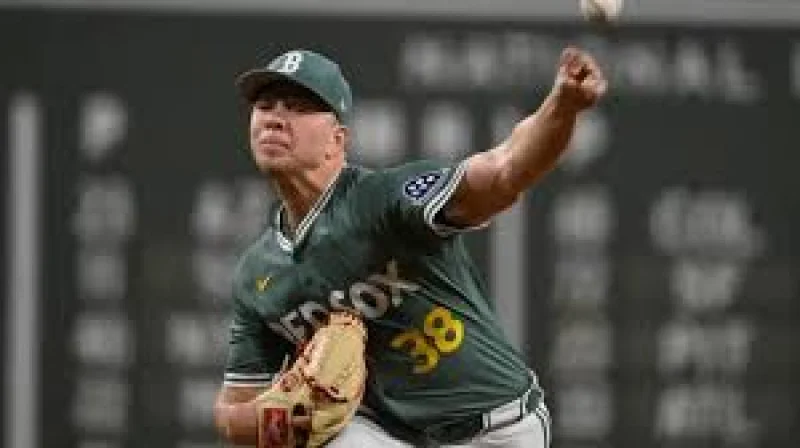
The Boston Red Sox thought they were solving a roster problem when they traded Kyle Harrison to Milwaukee this past offseason for Caleb Durbin. A few weeks into the 2026 season, they are watching Harrison dominate and Durbin struggle while the standings turn the deal into a painful reminder of what Boston gave away.
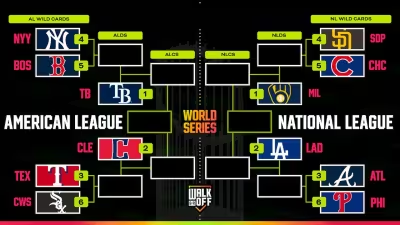
Harrison, 24 years old, has become one of MLB’s best arms through the first month and is carrying a 1.77 ERA. That would have been welcomed warmly in Boston, where the Red Sox are 22-27 through 49 games and sit in fourth place in the AL East. Milwaukee, by contrast, is 29-15 and on top of the NL Central. The mismatch has fueled the reaction around a trade that looked defensible on paper but is drawing harsher reviews now that the results are in.
The move made sense in the moment. Boston had lost All-Star Alex Bregman at third base and needed a replacement at the hot corner, while Durbin was coming off a Milwaukee season in which he posted a.721 OPS and 2.8 WAR. Harrison also had a profile that made him tempting to move: before Boston got him in the blockbuster Rafael Devers trade, he had already been a top prospect with the San Francisco Giants. The Red Sox then flipped him again, betting that a utility infielder would better fit their needs.
That gamble is looking rough. One baseball analyst said Harrison’s 2026 transformation has been obvious: his arm angle has risen from 27 degrees to 33 degrees, he moved to the first-base side of the rubber and, after failing to learn Connelly Early’s kick-change grip, Hayden Birdsong helped him solve it over the offseason. In other words, Boston did not just give up a talented arm; it traded away a pitcher whose development has accelerated right after leaving.
The backlash has been even sharper because of what the Red Sox were trying to replace. One critic argued that Craig Breslow cannot run the club if he is moving a 24-year-old left-hander who had been viewed as a top 20-25 prospect in baseball for Caleb Durbin, saying that if Boston was going to trade Harrison, it should have been for a middle-of-the-order bat rather than a utility infielder. Another noted that the Brewers remain the Brewers even after losing their ace pitcher this offseason because they keep finding ways to win deals like this one.
There is also no escaping the larger accounting around the Rafael Devers chain of transactions. Harrison came to Boston in that blockbuster before being moved again, and the whole sequence now reads like a set of trades that keeps circling back on the Red Sox. One observer summed up the run of moves bluntly: Harrison for Durbin, James Tibbs III for two months of Dustin May, Jordan Hicks dumped with David Sandlin for Gage Ziehl, Jose Bello still here, and money saved for Ranger Suarez.
Boston fans are sick of the move, and the standings are making it worse. Harrison’s sub-2.00 ERA would have been a luxury in a rotation that has not separated itself, while Durbin’s bat has not given the Red Sox the kind of production they needed after Bregman’s departure. Milwaukee, meanwhile, is getting the benefit of both the player it kept and the one Boston let go.
For now, the trade is no longer just part of the Rafael Devers fallout. It is becoming one of the clearest examples of how quickly a deadline or offseason decision can look smart in January and costly by May.