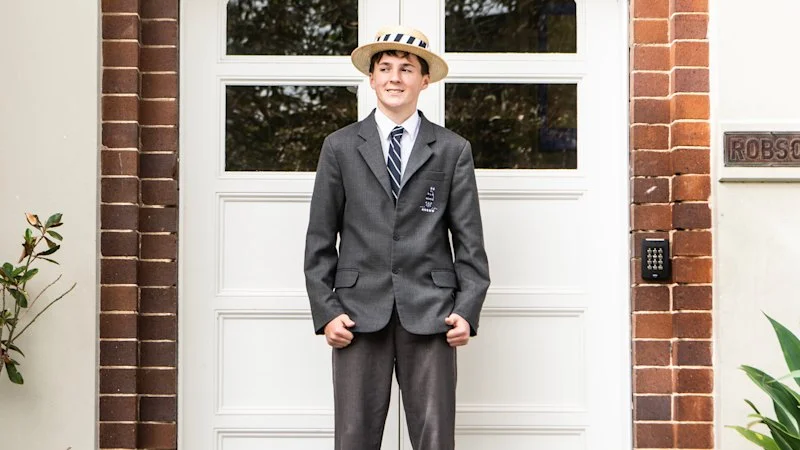
Daniel Ritchie’s day as a boarding school student began just before 7am, with roll call at 7.15am, breakfast, and about 20 minutes of phone time before lessons started. Phones were unlocked again in the morning, then locked away by 9.45pm, after a day that ran from 8.20am to 2.50pm, dinner at 6pm, another roll call and two hours of study.
Ritchie, who graduated year 12 last year, said the structure was what made the system work for him. “You get a bit of phone time, talk to your parents, whatever, and then you put them back,” he said. “I thought it was crazy … I’ve just never been that structured before.”
He first arrived at Shore in year 10 after growing up on a farm about 20 minutes outside Orange. The first months were hard, he said, and he wanted to leave often. But once he settled in, he said the routine became the reason he thrived. “The first year, I struggled a lot, and actually wanted to come back a lot of the time. But when I really found my feet, it became … the best experience ever, and I’m just so grateful that I was able to go there,” he said.
That experience is part of the pitch Shore is making as it tries to show parents that boarding is not frozen in the past. The school conducted a YouGov poll earlier this month and found 80 per cent of parents. Shore headmaster Dr Peter Miller said boys’ boarding has changed over the past four decades. “My key messages to people about boarding is that it has changed,” he said. “And it’s really interesting to see this seems to be a wider perception that that’s the case, that it has evolved, and it is a more human environment, as indeed I think schools are.”
The broader picture helps explain why the school is pressing the point now. The number of NSW students in boarding schools over the past five years has remained relatively stable despite rising costs, and schools say most parents who sign up their children were normally boarders themselves. Australian boarding schools opened in the 19th century and copied long-standing British traditions, with King's opening in 1832, Sydney Grammar in 1857, Newington in 1863 and The Scots College in 1893.
Rex Bassingthwaighte’s path shows the same system from another angle. He signed a four-year deal to start with the Roosters NRL club in 2024, but said boarding at Shore helped set him up for that step. “I really wanted to get out of Dubbo and sort of spread my wings a bit and explore, you know, something a bit more than Dubbo,” he said. He said he was close with boarding housemaster Brendan Morris, adding: “He was like a dad for most of us. If you got in trouble, he was there to help you. He wasn’t there to get angry.”
That is the tension in the boarding debate now: families are still being asked to trust a system with strict hours, shared rules and old associations, while schools insist the model has softened into something more supportive. The routines have not disappeared. But for students like Ritchie and Bassingthwaighte, they are being sold less as discipline for its own sake than as the framework that helped them move on.