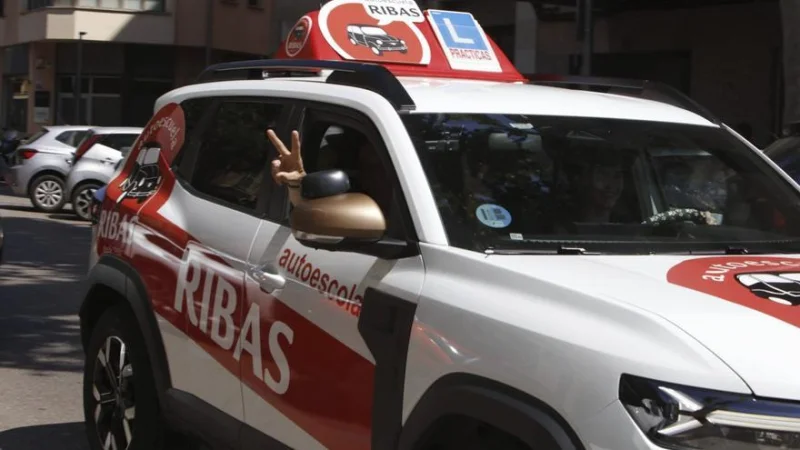
Mallorca still offers driving-school training at comparatively low cost, even as the price of getting a license in Germany has climbed sharply. For many students, the island’s appeal is not only price but the fact that much of the theory can be learned without Spanish knowledge, with the exam at the traffic authority available in German.
The theory test is straightforward in format and unforgiving in practice: 30 multiple-choice questions, one correct answer each, and only three mistakes allowed. At Autoescuela Km 2.0 in Palma, an employee says that since the pandemic practically nobody comes in person to theory class anymore. Students study from books, websites, online courses or in-person material, but the message from the school is blunt: “Um das Büffeln kommt keiner herum.”
That contrast with Germany is stark. Twenty years ago, a B driving license there cost about 1,500 euros. An ADAC test from the previous year put the total at between 2,466 and 4,476 euros. On Mallorca, the training cost is described as still comparatively low, and most lessons are concentrated in Palma, where the island’s traffic is heaviest. There are no special night, countryside or motorway lessons, which keeps the training process simpler than the one many German learners know.
The island’s licensing rules also shape who learns and how. Since last year, Spain has allowed a driving license from age 17 if an experienced driver rides as co-pilot until adulthood. For school enrollment on Mallorca, a NIE number must be presented. Residents on the island must also exchange a German driving license for an EU license, a reminder that the paperwork around driving is as important as the lessons themselves.
There is, however, a hard edge to the system. Police can annul a passed theory exam if they catch students driving without a license, and that student is barred for two years. The school employee also rejects the idea that anyone can breeze through with a promise of a guaranteed pass. “Das ist Quatsch,” the employee says, adding that test-takers have to watch the wording carefully because a question can hide a double negative. “Man muss präzise auf die Formulierung achten. Manchmal ist eine doppelte Verneinung in die Frage gemogelt.”
That warning matters because the exam is not the only hurdle. Mallorca still has many driving-school providers, but the island has lacked a German driving school since Michael Piontek died two years ago. In villages, parents commonly let their children practice driving, a habit that sits uneasily alongside the formal rules but shows how local practice and official licensing often coexist.
The practical lesson from Mallorca is that the island is still cheaper and simpler than Germany for many learners, but not casual. The theory can be taken in German, the exam structure is fixed, and the rules are enforced. Even where the price looks friendlier, the road to a license still runs through study, paperwork and a test that leaves little room for guesswork.
For readers following Mallorca beyond the driving-school business, the island is also moving toward a different kind of pressure point this week in football, with Real Mallorca preparing for the home match against Oviedo. Coverage of the buildup has already been tied to the closing stretch of the season, including Mallorca – Real Oviedo and the broader buildup around Mallorca Vs Oviedo as the club heads toward the decisive Jornada 38.