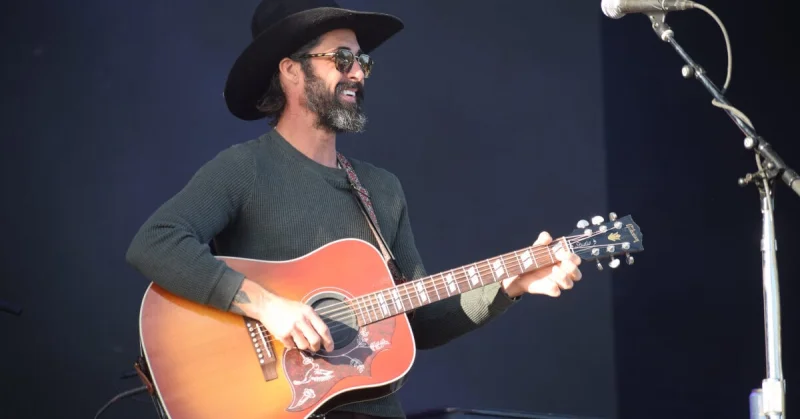
Ryan Bingham has always had a busted voice, and he knows exactly what to do with it. On They Call Us The Lucky Ones, his first real full-length album in seven years, he turns that weathered rasp into the center of a record that sounds loose, lived-in and built for the road.
The album is not billed as a solo reset so much as a shared venture. The Texas Gentlemen, who have been touring with Bingham as his backing band for a few years now, are on the front cover with him and contribute enough to shape the sound in a real way. That matters because Bingham, at his best, has always depended on three things: voice, songs and image.
The songs here are not always remarkable, but the album has enough easy momentum to carry itself. “Let The Big Dog Eat” is fun to sing along to, “The Ballad of the Texas Gentlemen” is built as a good road song, and “Americana” plays like a silly kiss off of sorts. “Blue Skies” keeps things simple as a cowboy love song, while “I Got A Feelin'” works as a solid anthem for down times.
The strongest stretch comes with “Cocaine Charlie,” which runs nearly 7 minutes and starts as storytelling before building into something like a Cormac McCarthy epic. That kind of sweep is where Bingham’s rough voice and the band behind him click most clearly. Richard Bowen’s fiddle and mandolin help give the record its grain, while Ryan Ake, Cody Huggins, Daniel Creamer, Scott Lee and Paul Grass fill out a lineup that sounds less like a backup unit than a working band with a point of view.
That is also the tension running through the album. Bingham is still being sold as an Americana artist whose appeal rests on grit, songs and the image of a worn-in troubadour, but the record is more interesting when The Texas Gentlemen stop acting like support and start sounding like collaborators. The front-cover billing is not just decoration; it is the clearest sign that this is not meant to be another lone-wolf statement.
Whether that arrangement changes Bingham’s standing is another question. He is a B-level actor at best, and this album does not try to turn him into something he is not. What it does is give him a sturdier frame for the things he has always done well, and in that sense They Call Us The Lucky Ones feels less like a reinvention than a reminder of how effective he can be when the band is as present as the voice.