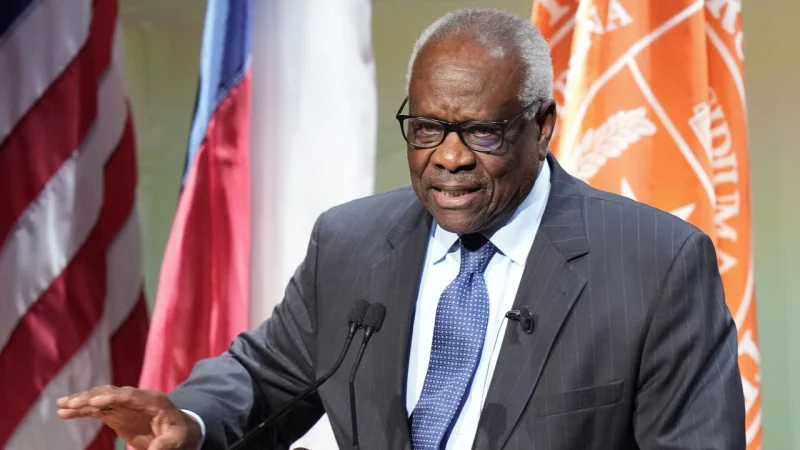
Clarence Thomas is now the second-longest-serving Justice in history, and the 77-year-old is not sounding like a man trying to soften the edge of his judicial philosophy. A few weeks before he passed John Paul Stevens’s 34-year mark earlier this month, Thomas delivered a lecture in Austin that put his old arguments about rights, government and the Constitution back at the center of his public life.
At the University of Texas at Austin, speaking at the invitation of its new School of Civic Leadership, Thomas said the Declaration of Independence, not the government, is where rights begin. “None of our rights come from the government,” he said. “It is the Declaration that announces the ends of government.” He added that the Constitution protects “our natural rights and our liberties from concentrated power and excessive democracy.”
The speech landed with extra weight because Thomas has spent decades pressing that same view from the bench. During his 1991 confirmation hearings, he said taking the bench meant having to “strip down, like a runner, to eliminate agendas, to eliminate ideologies.” In Texas, he returned to that language of discipline and restraint, saying it is “an amazing process” because “you start putting the speeches away” and “the policy statements away.” But his own public remarks have shown how tightly he still links jurisprudence to a broader conservative project.
That project has become more visible in recent years. The School of Civic Leadership that hosted him is part of a wave of conservative-inflected entities being created at public universities in Republican states, a setting that gave Thomas a ready-made audience for a lecture about founding documents and the limits of state power. His appearance came only a few weeks before he became the Court’s second-longest-serving justice, and it placed him at the center of a debate that stretches far beyond one campus.

Thomas has long argued that rights come from the Declaration rather than from elected government. That view sharpened in 2015, when he dissented in Obergefell v. Hodges and complained that the majority rejected the Declaration’s idea that human dignity is innate and instead suggested it comes from the government. In Austin, he tied the Constitution to the same principle, saying it exists to protect liberty from “concentrated power and excessive democracy,” a phrase that leaves little doubt about how he sees the risks of modern politics.
He also used the lecture to revisit a deeper frustration with his profession. “They get so swept up in the euphoria of acclamation and acceptance that they put aside their convictions,” he said of some conservatives, adding that they “water down their message, negotiate against themselves, vote against their principles, and hide in the tall grass.” It was a familiar rebuke from a justice who has often presented himself as unwilling to bend for approval.
Thomas also spoke about the Court’s long delay in ending segregation-era precedent. He said it “did not take me long, in Washington, to stop wondering why the Supreme Court took sixty years to overrule Plessy v. Ferguson,” the 1896 decision that endorsed government-enforced racial segregation and validated the Jim Crow South he grew up in. He said the justices must have known Plessy was “a hideous wrong,” and suggested they may have stayed silent because they feared “losing their social standing” and “bad press.”
That is the tension in Thomas’s latest milestone. He is a record-setting justice whose public voice still sounds like a corrective to the Court, not a celebration of it. If he remains on the bench until May 20, 2028, he will pass William O. Douglas’s 36-year tenure, a benchmark Thomas has now moved within reach. For now, the better answer to the question his long service raises is this: he is using the extra years not to moderate his views, but to press them harder.