


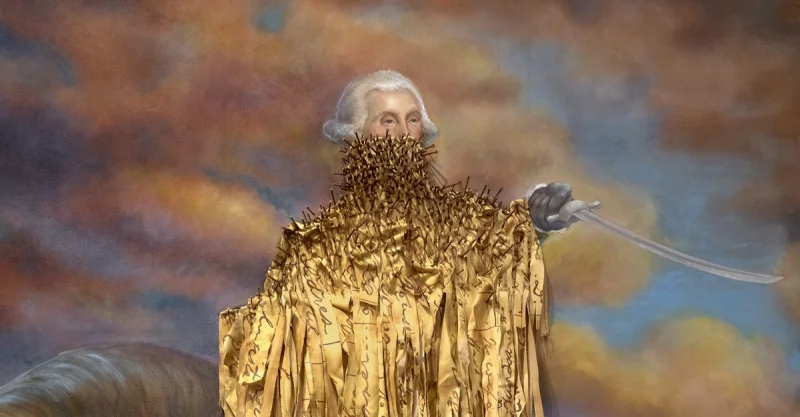
George Washington is getting a hard look in Richmond, and it is not the kind that leaves him on a pedestal. A new exhibition at the Virginia Museum of Fine Arts, titled “Titus Kaphar and Junius Brutus Stearns: Pictures More Famous Than the Truth,” places 19th-century scenes of Washington’s life beside six works by contemporary painter and sculptor Titus Kaphar.
The show arrives as part of Virginia’s state commemoration of the semiquincentennial, and it does something rare for an American museum exhibition: it treats Washington as both a founding hero and a man who enslaved many others. Stearns’ paintings are not portraits but imagined scenes, yet they circulated widely in their own time and are still familiar enough to turn up in the Story of America videos. Kaphar, by contrast, approaches the same figure with seriousness and respect, but without the smoothing effect of monument-making.
That balance is the point. Kaphar wants viewers to see Washington as “a once-in-a-nation’s-lifetime hero” and also as a flawed human being who enslaved many people. The artist, who is married to a descendant of Washington’s, brings that tension into view through work that ranges from conventional oil on linen to uncommon materials such as torn fabric and sculpted tar. Two sculptures are included in the show, alongside paintings that resist any easy separation between reverence and reckoning.
Washington has long been treated as an American visual cliché, a face so familiar it can seem to stand in for the nation itself. The exhibition pushes back against that flattening at a moment when the country is moving toward the 250th anniversary of its founding and museums are being pressed to revisit the stories they tell about the people at the center of it all. Kaphar’s presence in the gallery matters because it places a living artist’s response inside a state-sponsored remembrance, rather than outside it.
The friction in the exhibition is not subtle. Stearns helped build the myth by giving audiences dramatic episodes from Washington’s life, the sort of scenes that make a nation feel certain about its origins. Kaphar answers with works that keep the myth in frame but refuse to let it close the case. That is what gives the show its force: it does not ask visitors to choose between honoring Washington and confronting what he did. It shows that the American habit of sanctifying him was always carrying the truth along with it.
That is why the exhibition lands now. The semiquincentennial will bring more celebrations, more symbols and more polished versions of the past. This show argues, quietly but firmly, that Washington can no longer be understood only as marble and myth. In Richmond, he is being presented as he has always been — central, contradictory and impossible to turn into a saint.
