


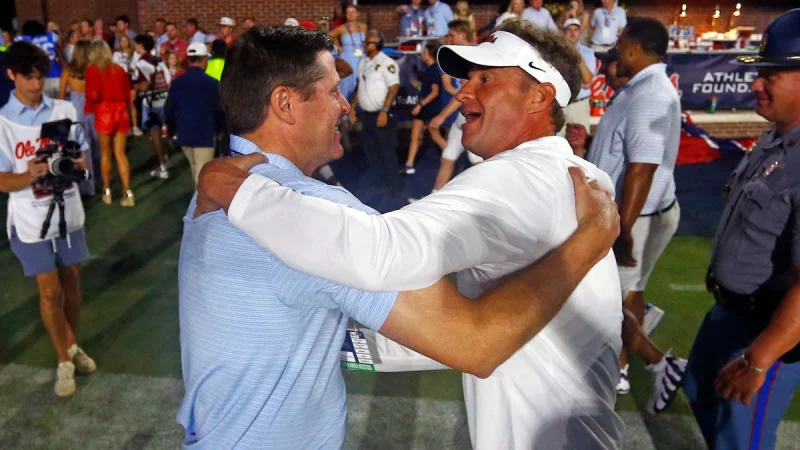
Lane Kiffin left Ole Miss two weeks before the Rebels were set to start their quest for a College Football Playoff title, and the timing turned a coaching change into a national argument. On the Saturday after the Egg Bowl, Kiffin told Keith Carter he was not signing a new contract with Ole Miss and was taking the LSU job.
That answer settled the job question, but it did not settle the bigger one around Ole Miss. Carter had already made clear more than a month earlier that if Kiffin left, he would not coach the Rebels in the postseason. When Kiffin committed to LSU, Ole Miss was not going to let him become a walking billboard for a rival program while still having an open door to take players with him to Baton Rouge.
The refusal mattered because the Rebels were heading into the playoff with a coach who had just chosen another SEC school. Some people across college football argued that Kiffin should have been allowed to stay on the sideline anyway, but Ole Miss would have made a horrible decision if it had let the storyline become one of a head coach serving two different SEC teams at once. The school was being asked to trust a coach who had already decided his next stop.
The fight over that choice stretched across the past five months, long after the Egg Bowl and long before the playoff bracket was set. It also ran into Kiffin’s own public comments about recruiting in Oxford, where he recently said it was difficult because of “past racial tensions still supposedly rearing its head.” Those remarks only added to the irritation around a breakup that had already turned messy.
There was also a sharp contrast in how the two schools handled the moment. The article says LSU Athletic Director Verge Ausberry represented common sense on the issue, while Carter drew a firm line and stuck to it. That distinction mattered because the debate was never really about whether Kiffin was a good coach. It was about whether a program chasing a playoff run should ask its players to keep following a coach who had announced he was leaving.
Dan Dakich put the criticism in starker terms, saying Kiffin should stand by his comments about Ole Miss knowing he would hurt the school the whole time. That view, whether fair or not, captured the mood surrounding the departure: Kiffin was not pushed out by uncertainty so much as by the consequences of a choice he had already made.
By the time Ole Miss moved on, the program was left defending a basic principle that often gets blurred in modern college football: once a coach leaves for another job, the old one ends. In this case, Carter enforced that line before the playoff spotlight could turn the Rebels’ postseason into a sideline drama.
